Buy FTO substrates (fluorine-doped tin oxide glass) for solar cells, sensors, electrochromic devices, and semiconductor research requiring transparent conductive coatings with high stability and low sheet resistance.
FTO-Coated Glass Substrates for Research
UniversityWafer supplies FTO-coated glass substrates
for research requiring a transparent electrically conductive surface.
FTO, or fluorine-doped tin oxide (SnO2:F),
is commonly deposited on glass and used as a transparent electrode in
solar cells, photoelectrochemical devices, sensors, electrochromic
structures, photocatalysis, and thin-film research.
FTO substrates can be selected according to
sheet resistance, glass thickness, dimensions, optical
transmission, coating properties, and surface requirements.
Researchers can also request pieces or substrates suitable for subsequent
dicing into smaller samples.
Research Example: FTO and ITO Coated Glass
A postdoctoral researcher requested approximately 500 small transparent
conductive substrates and asked about both FTO-coated and ITO-coated glass.
Requested specifications:
Material: FTO-coated glass or ITO-coated glass
Preferred dimensions: Approximately 1/2 × 1/2 inch
Quantity: Approximately 500 pieces
FTO option quoted:
FTO glass substrate: TEC 15
Dimensions: 1 × 1 inch
Glass thickness: 2.2 mm
Sheet resistance: 12–14 Ω/sq
ITO option quoted:
ITO-coated glass substrate
Dimensions: 10 × 10 mm
Glass thickness: 0.7 mm
Sheet resistance: 9–15 Ω/sq
Nominal ITO film thickness: 180 nm
Reference #139874
These specifications are examples from a previous research request and
should not be interpreted as the only available FTO or ITO configurations.
Current dimensions, coating specifications, and quantities should be
confirmed when requesting a quote.
Choosing FTO Sheet Resistance
Sheet resistance, typically expressed in ohms per square
(Ω/sq), is one of the most important specifications when selecting an FTO
substrate. Lower sheet resistance generally provides better lateral
electrical conduction, while the FTO coating must also provide suitable
optical transmission for the intended device.
The best specification depends on the application. Researchers should
consider both electrical and optical requirements rather than selecting
an FTO substrate based on sheet resistance alone.
Transparent Conductive Substrates for Chemical Research
FTO and
ITO
are commonly considered when an experiment requires a substrate that is
both optically transparent and electrically conductive.
Material selection becomes especially important when the conductive
coating will be exposed to electrolytes, acids, bases, elevated
temperatures, deposition processes, or repeated electrochemical cycling.
Research Example: Conductive Glass for Chemical Exposure
A PhD researcher requested transparent conductive substrates that could
be diced into smaller pieces and exposed to mildly acidic and basic
solutions.
Requested properties:
Transparent conductive substrate
FTO or ITO acceptable
Final diced pieces from approximately 1 × 1 cm to 1 × 2 inches
Glass thickness sufficient for convenient laboratory handling
High optical transparency desired
Good electrical conductivity required
Exposure to mild acidic and basic solutions anticipated
Reference #103101
For chemical or electrochemical applications, researchers should identify
the expected solution chemistry, pH range, exposure time,
temperature, applied potential, and cleaning procedure. Chemical
compatibility depends on the complete experimental environment and should
be evaluated for the specific FTO coating and substrate.
FTO vs. ITO: Which Transparent Substrate Should You Choose?
Both FTO and ITO can provide transparent electrically conductive surfaces,
but the best choice depends on the device and processing conditions.
Researchers should compare actual substrate specifications rather than
assuming one transparent conductive oxide is always superior.
Specification
Why It Matters
Sheet Resistance
Influences lateral electrical conduction and resistive losses.
Optical Transmission
Important when light must pass through the conductive electrode.
Surface Roughness
Can affect thin-film deposition, interfaces, and device uniformity.
Coating Thickness
Influences electrical, optical, and surface properties.
Glass Thickness
Affects handling, mechanical rigidity, and device geometry.
Thermal Compatibility
Important for annealing and high-temperature film processing.
Chemical Compatibility
Important for electrochemistry, cleaning, etching, and solution processing.
FTO Substrates for Thin-Film Deposition
The conductive FTO surface can serve as a starting electrode for
thin-film deposition
and solution-based coating processes. Researchers can deposit functional
semiconductor, oxide, catalytic, polymer, or electrochemical layers onto
the FTO surface.
Common research materials deposited on FTO can include:
TiO2
ZnO
Perovskite absorber layers
Metal-oxide semiconductor films
Electrochromic materials
Catalytic coatings
Organic and polymer films
FTO Substrate Applications
The combination of optical transmission and electrical conductivity makes
FTO-coated glass useful as a substrate and electrode platform for:
Solar cells
including DSSC and perovskite photovoltaic research
Photoelectrochemical water splitting
Photocatalysis and solar-fuel research
Electrochromic smart windows
Electrochemical and optical sensors
Thin-film semiconductor research
Transparent electrode development
Experimental optoelectronic devices
How to Specify an FTO-Coated Glass Substrate
Providing detailed specifications helps identify the most appropriate
FTO glass substrate for your experiment.
Substrate length and width
Glass thickness
Required sheet resistance (Ω/sq)
Optical transmission requirements
FTO coating thickness, if required
Surface roughness requirements
Patterned or unpatterned coating
Required processing temperature
Chemical exposure conditions
Whole substrates or diced pieces
Required quantity
Get Your FTO Substrate Quote FAST!
Or,
Buy Online
and Start Researching Today!
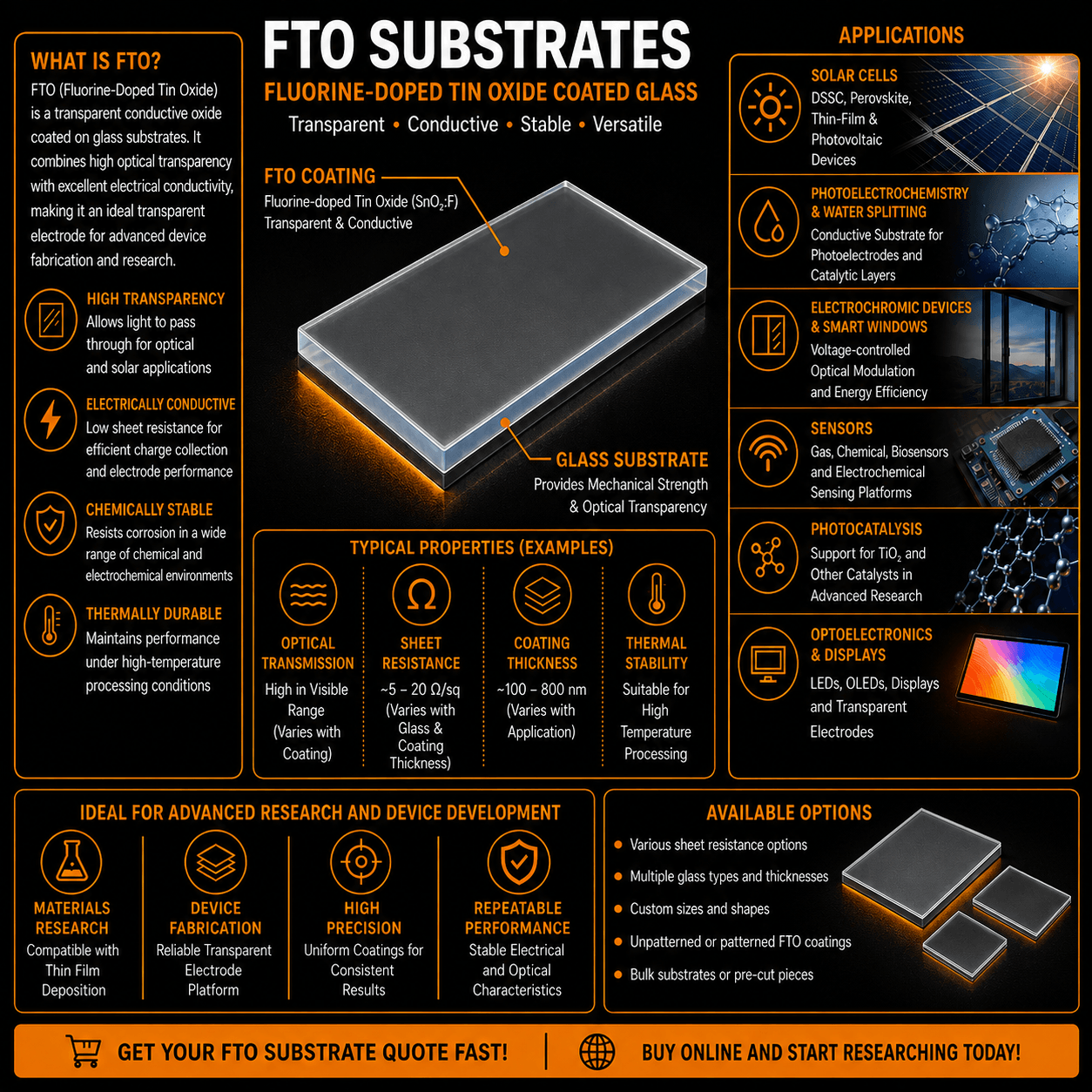
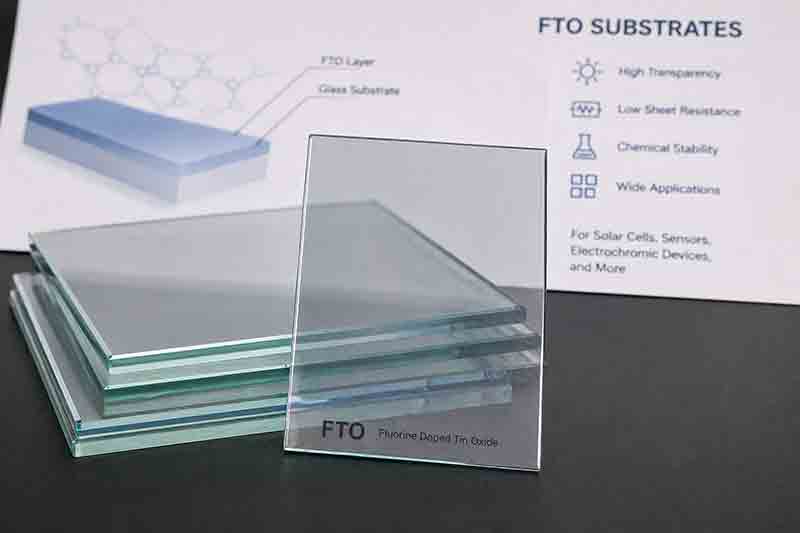
What Is an FTO Substrate?
An FTO substrate is typically a glass substrate coated with
fluorine-doped tin oxide (SnO2:F), a transparent
conducting oxide (TCO). The FTO coating combines optical transmission with
electrical conductivity, allowing the same surface to transmit light and
function as an electrode.
Fluorine doping increases the electrical conductivity of tin oxide while
retaining useful optical transparency. This combination makes
FTO-coated glass useful for solar cells, electrochemical
devices, sensors, photocatalysis, electrochromic devices, and other
optoelectronic research.
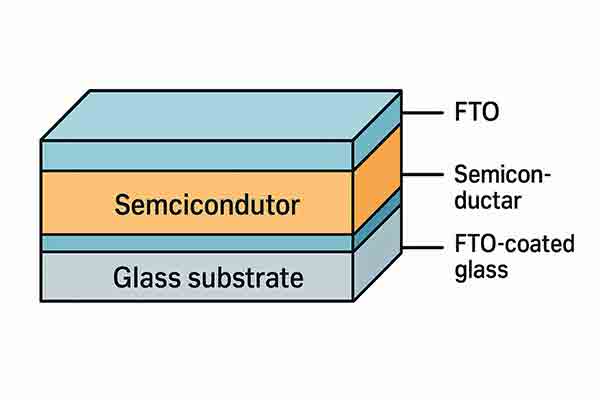
How Is an FTO Substrate Structured?
The simplest FTO substrate consists of two main layers:
Glass substrate:
Provides mechanical support and optical transmission.
FTO conductive coating:
Provides the transparent electrically conductive surface used as an
electrode or contact layer.
Researchers can then deposit semiconductor, catalytic, dielectric, or
electrochemically active materials onto the FTO surface. Depending on the
device, these layers may include TiO2, ZnO, perovskite absorbers,
electrochromic oxides, catalysts, polymers, or other functional materials.
FTO-Coated Glass as a Transparent Conductive Substrate
Why Use FTO-Coated Glass?
FTO is selected when a device requires a surface that combines
electrical conductivity, optical transmission, chemical durability,
and compatibility with subsequent thin-film processing.
Important FTO properties include:
Optical transparency:
FTO can provide useful transmission through much of the visible spectrum,
depending on coating thickness, carrier concentration, substrate, and
wavelength.
Electrical conductivity:
Fluorine doping reduces the resistivity of SnO2, allowing the
coating to function as a transparent electrode.
Thermal stability:
FTO is often selected for processes involving elevated-temperature
deposition or annealing, although the allowable temperature depends on
the complete FTO/glass substrate system.
Chemical durability:
FTO can provide useful stability in many electrochemical and thin-film
processing environments.
Patternability:
FTO coatings can be patterned for electrodes, device areas, contacts,
and experimental structures using appropriate fabrication techniques.
FTO vs. ITO Transparent Conductive Substrates
FTO and indium tin oxide (ITO) are both
transparent conducting oxides, but neither material is universally better.
The appropriate choice depends on electrical, optical, thermal, chemical,
surface, and fabrication requirements.
Property
FTO
ITO
Composition
Fluorine-doped SnO2
Tin-doped In2O3
Primary Function
Transparent conductive electrode
Transparent conductive electrode
Optical Transmission
High when properly optimized
High when properly optimized
Electrical Conductivity
Good
Often very high in optimized films
High-Temperature Processing
Often advantageous
Depends strongly on film and process conditions
Common Research Uses
Solar cells, electrochemistry, photocatalysis, sensors
Displays, optoelectronics, electrodes, sensors
Researchers should compare actual sheet resistance, optical
transmission, surface roughness, coating thickness, substrate material,
and thermal requirements rather than selecting a TCO based only
on its material name.
FTO Substrates for Solar Cells
One of the most common uses of
FTO-coated glass is photovoltaic research.
The FTO layer can serve as a transparent front electrode, allowing incoming
light to reach the photoactive layers while providing an electrically
conductive path for charge collection.
FTO substrates are commonly investigated in:
Dye-sensitized solar cells (DSSCs)
Perovskite solar cells
Thin-film photovoltaic research
Photoelectrochemical solar-energy systems
FTO in Dye-Sensitized Solar Cells
In a typical dye-sensitized solar cell, a semiconductor layer such as
TiO2 is deposited onto conductive FTO-coated glass. The
transparent electrode allows illumination through the substrate while
providing electrical contact to the photoelectrode.
A simplified DSSC configuration can be represented as:
Actual device architectures vary, but the FTO layer generally serves as
the transparent conductive contact supporting the semiconductor
photoelectrode.
FTO Substrates for Perovskite Solar Cells
FTO-coated glass is also widely used as a starting substrate for
perovskite photovoltaic research. Depending on the device
architecture, electron-transport, hole-transport, interfacial, and
perovskite absorber layers can be deposited above the conductive FTO
electrode.
FTO can be particularly useful when the device fabrication process requires
thermal treatment or when researchers need a robust transparent electrode.
FTO for Photoelectrochemistry and Water-Splitting Research
FTO-coated glass is frequently used as a conductive support for
photoelectrochemical electrodes. Semiconductor and
catalytic materials can be deposited onto the FTO surface while the
conductive oxide provides electrical connection to external measurement
equipment.
Materials investigated on FTO can include TiO2, ZnO, iron
oxides, metal-oxide catalysts, and other semiconductor or catalytic films.
These structures are studied for applications including:
Photoelectrochemical water splitting
Hydrogen-generation research
Photocatalysis
Electrochemical energy conversion
Semiconductor-electrolyte interface studies
FTO for Electrochromic Devices and Smart Windows
Electrochromic devices use electrically induced changes
in optical transmission or absorption. FTO can serve as a transparent
electrode through which voltage is applied to the active electrochromic
layers.
Research applications include:
Smart windows
Variable-transmission glazing
Electrochromic displays
Optically tunable devices
FTO Substrates for Sensors
The combination of conductivity and optical access also makes FTO useful
as an electrode platform for chemical, biological, gas,
electrochemical, and photoelectrochemical sensors.
Functional sensing layers can be deposited or patterned onto the FTO
surface while the conductive film provides electrical contact for
measurement.
FTO for Optoelectronic Devices
FTO may also be investigated as a transparent electrode in LEDs, displays,
photodetectors, and other optoelectronic structures. Whether FTO is
preferable to ITO or another transparent conductor depends on factors such
as required sheet resistance, transmission spectrum, surface roughness,
processing temperature, work function, and device architecture.
What Are FTO Substrates Used For?
FTO-coated glass substrates are used across energy,
semiconductor, optical, electrochemical, and sensor research.
Solar cells – transparent electrodes for DSSCs,
perovskite cells, and thin-film photovoltaic research
Photoelectrochemistry – conductive substrates for
water splitting and solar-fuel experiments
Photocatalysis – support for TiO2 and
other photocatalytic films
Electrochromic devices – transparent electrodes for
smart windows and variable-transmission devices
Sensors – electrochemical, biological, chemical,
gas, and optical sensing platforms
Optoelectronics – transparent electrodes for selected
LEDs, displays, photodetectors, and experimental devices
Thin-film research – conductive substrates for
deposition, characterization, and materials development
Applications of Fluorine-Doped Tin Oxide Substrates
How to Select an FTO Substrate
Researchers should select FTO-coated glass according to the electrical,
optical, dimensional, and processing requirements of the experiment.
Important specifications can include:
Substrate dimensions
Glass thickness
FTO coating thickness
Sheet resistance (Ω/sq)
Optical transmission
Surface roughness
Coated-side identification
Maximum required processing temperature
Patterned or unpatterned FTO
Required quantity
Sheet resistance and optical transmission are especially important because
transparent conductive electrodes require a balance between
conductivity and transparency. The optimum specification
depends on the device rather than on a single universal FTO value.
Related Transparent Conductive Substrate Resources