
Get Your Thin Film Coating Quote FAST!
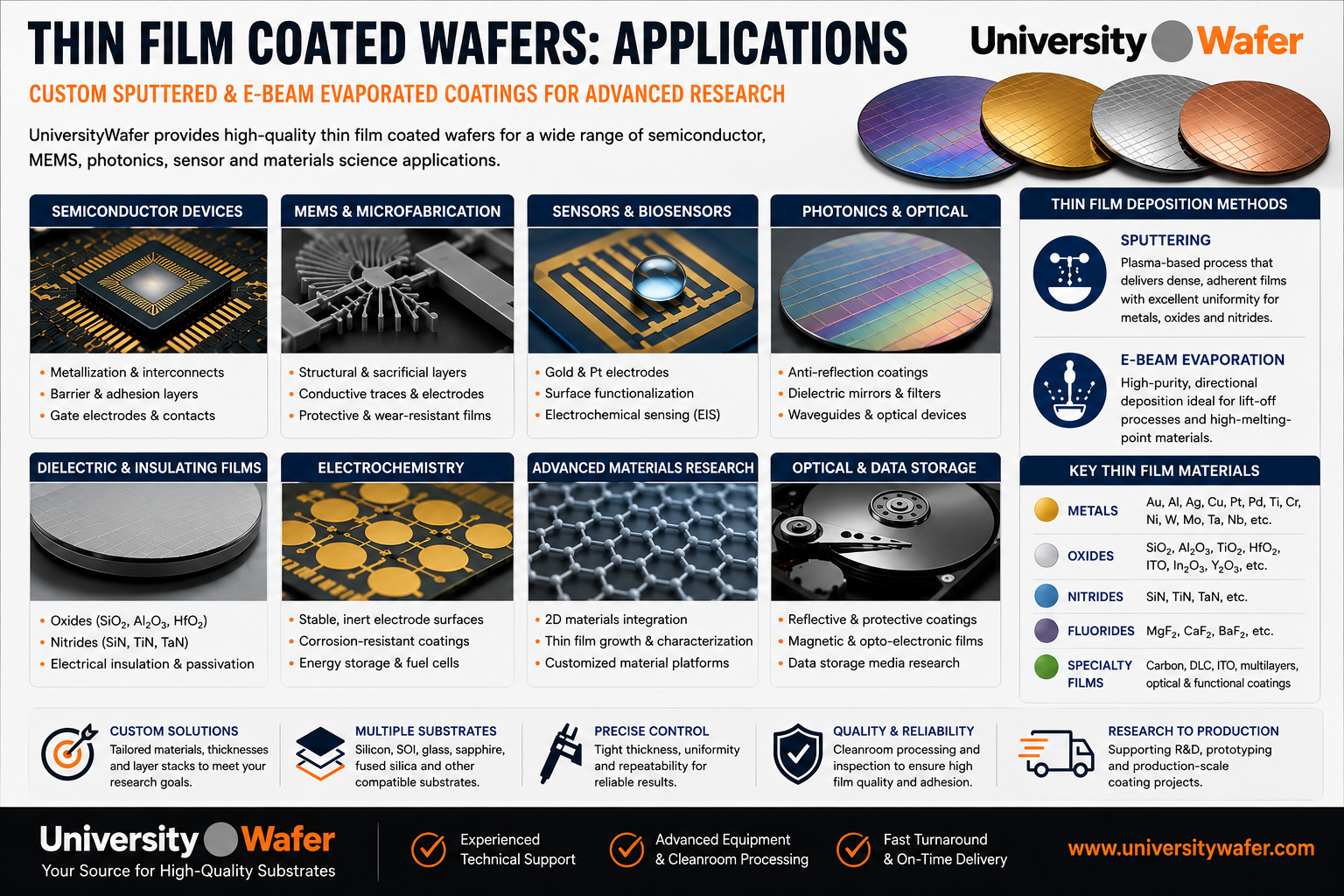
UniversityWafer, Inc. supplies custom thin-film coated wafers for semiconductor, MEMS, photonics, sensors, electrochemistry and materials research. Coatings may be deposited on silicon, SOI, glass, sapphire, fused silica and other compatible substrates.
Available coating options include metals, adhesion layers, refractory metals, oxides, nitrides, conductive oxides and optical films using sputtering, electron-beam evaporation and other compatible deposition processes.
Tell us your substrate, film material, target thickness, layer stack and quantity.
Or, Buy Wafers Online and Start Researching Today!
Substrates We Can Coat
Thin-film deposition can be performed on a variety of research substrates, provided the material is compatible with the deposition process, vacuum environment and temperature requirements.
- Silicon Wafers – Prime, test, mechanical and research grades.
- SOI Wafers – Silicon-on-insulator substrates for MEMS and advanced device research.
- Glass Wafers – Fused silica, borosilicate and other glass substrates.
- Sapphire Wafers – Crystalline Al2O3 substrates in multiple orientations.
- Ceramic Substrates – Selected alumina, aluminum nitride and other compatible ceramics.
- Customer-Supplied Substrates – Subject to dimensional, cleanliness and process compatibility.
Metal Coated Silicon Wafers
Metal-coated silicon wafers are widely used for electrodes, electrical contacts, optical reflectors, sensors, MEMS structures, electrochemical experiments and thin-film materials research.
Common deposited metals may include Au, Al, Ag, Cu, Pt, Pd, Ti, Cr, Ni, W, Mo, Ta and Nb, depending on the selected deposition process and project requirements.
Learn more about gold-coated silicon wafers .
Why Use an Adhesion Layer?
Some metals do not adhere strongly to silicon dioxide, glass or other substrate surfaces. Gold is a common example. A thin intermediate layer such as titanium or chromium is therefore often deposited before the primary metal film.
A commonly requested structure might be:
Substrate / Ti / Au
The required adhesion-layer material and thickness depend on the substrate, final film, electrical requirements and subsequent processing. Researchers should specify whether the adhesion layer may remain in the completed structure.
Single-Layer and Multilayer Coatings
Thin-film projects are not limited to a single deposited material. Multilayer structures can combine adhesion layers, conductors, dielectrics, barriers and optical films.
Example research stacks can include:
- Si / Ti / Au
- Glass / Cr / Au
- Si / Ti / Pt
- Si / SiO2 / Metal
- SOI / Adhesion Layer / Electrode Metal
Multilayer stacks should be specified in the exact order that the films are to be deposited.
Thin Film Thickness Matters
Film thickness can influence electrical resistance, optical response, mechanical stress, adhesion and device performance.
Very thin films may be discontinuous depending on the material, substrate and deposition conditions, while thicker coatings can accumulate substantial intrinsic or thermal stress.
For this reason, researchers should specify both the target thickness and any allowable tolerance.
Film Stress and Wafer Bow
Deposited films can develop either tensile or compressive stress. Excessive stress may cause wafer curvature, film cracking or delamination.
Stress depends on factors including deposition conditions, film thickness, substrate material, microstructure and thermal-expansion mismatch between the coating and substrate.
If wafer bow, flatness or film stress is critical to your application, include those requirements with your quote request.
Blanket vs. Patterned Coatings
A blanket coating covers the exposed wafer surface, while patterned metal structures require additional fabrication steps such as lithography, masking, lift-off or etching.
If your project requires patterned features rather than a blanket film, include the patterning method, minimum feature size and any alignment requirements when requesting a quote.
Thin Film Coatings for MEMS
Thin-film coatings are frequently incorporated into MEMS fabrication as electrodes, conductive traces, resistive layers, optical coatings, adhesion layers and surface-functional materials.
MEMS structures can contain trenches, cavities and sidewalls, so feature geometry should be considered when selecting a deposition process. Highly directional deposition methods may not coat deeply recessed surfaces uniformly.
Thin Film Coatings for Sensors
Metal and dielectric films can provide active surfaces for chemical, biological, electrochemical and physical sensors.
Gold-coated substrates, for example, are commonly investigated for electrochemical electrodes and surface-functionalization experiments because gold is conductive and comparatively resistant to oxidation under many laboratory conditions.
Surface chemistry, adhesion layers, roughness and film thickness should still be selected according to the sensing application.
Optical Thin Film Coatings
Thin films can also be used to control reflection, transmission, interference and optical phase.
Materials such as MgF2, CaF2, oxides and selected metals may be used in optical coating research. The required material and thickness depend on wavelength, refractive index and the optical function of the stack.
Sputtering or E-Beam Evaporation?
There is no single deposition method that is best for every coating.
Sputtering is often useful for metals, alloys, refractory materials and reactive oxide or nitride deposition.
E-beam evaporation provides a relatively directional vapor flux and is commonly used for high-purity metal deposition and lift-off structures.
The appropriate method depends on the material, substrate geometry, required film properties and downstream fabrication process.
What Should You Specify?
Providing a complete coating specification helps determine whether the requested film can be produced reproducibly.
Include the following whenever possible:
- Substrate material
- Wafer diameter or dimensions
- Substrate thickness
- Surface finish
- Film material
- Target film thickness
- Thickness tolerance, if critical
- Adhesion or barrier layer
- Complete multilayer stack
- Sputtering or e-beam preference, if known
- Maximum process temperature
- Blanket or patterned coating
- Film stress or wafer bow requirements
- Quantity
Need a Custom Wafer Coating?
UniversityWafer, Inc. can help researchers source substrates and evaluate thin-film coating options for semiconductor, MEMS, photonics, sensor, electrochemical and materials-science applications.
Send us your substrate type, film material, target thickness, complete layer stack and quantity for a custom coating quote.
Thin Film Deposition & Wafer Coating Capabilities
UniversityWafer, Inc. supports research and production projects requiring thin-film coatings on silicon, glass, sapphire, SOI and other substrates. Available physical vapor deposition (PVD) methods include sputtering and electron-beam (e-beam) evaporation.
The appropriate deposition method depends on the film material, required thickness, substrate, adhesion requirements, patterning method, thermal budget, surface topography and desired film properties.
Sputtered Thin Films
Sputtering is a PVD process in which energetic ions from a plasma strike a solid target, ejecting atoms that travel to and condense on the substrate.
Sputtering is widely used for metals, alloys, conductive films, oxides and nitrides. It can provide dense films and strong adhesion when the substrate preparation and deposition conditions are properly controlled.
| Film Category | Available Materials |
|---|---|
| Conductive Metals | Aluminum (Al), Gold (Au), Silver (Ag), Copper (Cu) |
| Adhesion & Barrier Layers | Titanium (Ti), Chromium (Cr), Ti-W |
| Refractory Metals | Molybdenum (Mo), Tungsten (W), Tantalum (Ta), Niobium (Nb) |
| Magnetic Metals | Nickel (Ni), Iron (Fe), Cobalt (Co) |
| Oxides & Conductive Oxides | SiO2, Al2O3, TiO2, ITO |
| Nitrides | Silicon Nitride , TiN, TaN |
When Is Sputtering Useful?
Sputtering can be attractive when a project requires alloy deposition, refractory metals, conductive coatings, reactive oxide or nitride deposition, or films with good adhesion to a properly prepared substrate.
Film conformity and step coverage depend strongly on chamber geometry, gas pressure, substrate rotation, feature shape and process conditions. Sputtering should therefore not be assumed to coat every high-aspect-ratio structure uniformly.
E-Beam Evaporated Thin Films
Electron-beam evaporation is another PVD technique. A focused electron beam heats material contained in a crucible or hearth until it evaporates in vacuum. The vapor then travels toward the substrate and condenses to form a thin film.
Because the vapor flux is relatively directional, e-beam evaporation is frequently used in patterned metal processes and lift-off fabrication. The technique can also evaporate many high-melting-point materials without heating an entire crucible to the source-material melting temperature.
| Film Category | Available Materials |
|---|---|
| Noble Metals | Platinum (Pt), Palladium (Pd), Gold (Au) |
| Low-Melting Metals | Indium (In), Tin (Sn) |
| Oxides | HfO2, Y2O3, In2O3 |
| Optical Fluorides | MgF2, CaF2, BaF2 |
Sputtering vs. E-Beam Evaporation
| Property | Sputtering | E-Beam Evaporation |
|---|---|---|
| Deposition Type | Physical Vapor Deposition (PVD) | Physical Vapor Deposition (PVD) |
| Source Mechanism | Plasma ions eject atoms from a target | Electron beam heats and evaporates source material |
| Flux Directionality | Typically less directional than evaporation, depending on process conditions | Highly directional |
| Lift-Off | Possible, but process dependent | Frequently well suited |
| Alloy Deposition | Often well suited | Can be more challenging for some multicomponent materials |
| Reactive Films | Reactive sputtering can produce selected oxides and nitrides | Depends strongly on source chemistry and evaporation process |
Custom Metal Coated Wafers
Metal-coated wafers can be fabricated for electrical contacts, electrodes, optical structures, MEMS, sensors, adhesion studies and materials research.
Common stacks can include an adhesion layer such as Ti or Cr beneath a noble-metal layer such as Au. The appropriate adhesion material and thickness depend on the substrate, final application and subsequent processing.
Explore gold-coated silicon wafers for additional metal-coating options.
Oxide and Nitride Thin Films
Dielectric and ceramic coatings can be used for electrical insulation, optical structures, diffusion barriers, passivation, surface engineering, MEMS and thin-film research.
Materials such as SiO2, Al2O3, TiO2 and selected nitrides can be deposited using an appropriate PVD process when compatible targets and process conditions are available.
Deposited SiO2 should not be confused with thermal oxide . Thermal SiO2 is grown by oxidizing silicon, whereas sputtered SiO2 is deposited onto the substrate.
Thin Film Coatings for MEMS
Thin films are fundamental to MEMS fabrication . Deposited materials can function as electrodes, structural layers, optical coatings, resistive elements, adhesion layers or protective films.
MEMS coating requirements should consider feature geometry, film stress, deposition temperature, adhesion and whether the device contains cavities, sidewalls or high-aspect-ratio structures.
Carbon Thin Film Research
Carbon-based thin films can be investigated for electrical conductivity, tribological behavior, protective coatings, electrochemistry and surface engineering.
Film properties depend strongly on deposition method and bonding structure. Amorphous carbon, graphitic carbon, diamond-like carbon (DLC) and crystalline diamond are distinct materials and should not be treated as interchangeable coating types.
When requesting a carbon coating, researchers should specify the desired electrical, optical or mechanical properties in addition to nominal film thickness.
Example: Sputtered Carbon on SOI
One research project required a conductive carbon film on 4-inch SOI wafers . A sputtered carbon film of approximately 8,000Å (0.8 µm) was produced, with measured compressive film stress.
Thick sputtered films can develop substantial intrinsic and thermal stress, so target thickness, substrate properties, adhesion and allowable wafer bow should be considered when specifying thicker coatings.
Diamond-Coated Silicon Wafers
Crystalline diamond coatings should be distinguished from diamond-like carbon. Diamond is a crystalline carbon phase, whereas DLC generally refers to amorphous carbon films containing varying fractions of sp3 and sp2 bonding.
UniversityWafer has supported projects involving diamond films on Si(111) substrates . Crystal orientation, nucleation treatment, deposition method and thermal expansion mismatch can all affect diamond-film growth and adhesion.
Gold-Coated Wafers for Electrochemical Research
Gold-coated silicon wafers can provide conductive surfaces for electrochemistry, biosensors and Electrochemical Impedance Spectroscopy (EIS) .
Gold is valued because it is electrically conductive and comparatively resistant to oxidation under many laboratory conditions. Surface preparation, adhesion layers, electrolyte chemistry and functionalization can nevertheless strongly influence sensor performance.
Understanding Film Stress
Thin films can develop tensile or compressive stress during and after deposition. Excessive stress may cause wafer bow, cracking, delamination or changes in device performance.
Film stress can depend on deposition pressure, temperature, film thickness, microstructure, substrate material and differences in thermal expansion between the film and substrate.
If stress is critical to your project, include the allowable wafer bow, film thickness and post-deposition thermal processing requirements with your coating request.
Adhesion Layers for Metal Films
Noble metals such as gold may adhere poorly to some oxide and glass surfaces. A thin adhesion layer such as titanium or chromium is therefore commonly introduced before depositing the primary metal layer.
The correct adhesion stack depends on the substrate and application. Researchers should specify whether the adhesion layer can remain in the final device because it can influence electrical, optical and chemical behavior.
Substrates Available for Thin Film Coating
Thin films may be deposited on a variety of substrates depending on process compatibility, including:
- Silicon wafers
- SOI wafers
- Glass wafers
- Sapphire wafers
- Fused silica and quartz substrates
- Selected ceramic substrates
- Customer-supplied substrates, subject to process compatibility
How to Specify a Thin Film Coating
A complete coating specification helps determine whether sputtering, e-beam evaporation or another deposition method is most appropriate.
Include the following whenever possible:
- Substrate material
- Wafer diameter or dimensions
- Substrate thickness
- Surface finish
- Film material
- Target film thickness
- Adhesion or barrier layer requirements
- Single-layer or multilayer stack
- Required deposition method, if known
- Maximum allowable process temperature
- Patterned or blanket coating
- Film stress requirements, if critical
- Quantity
Request Custom Thin Film Coated Wafers
UniversityWafer, Inc. can help researchers source substrates and identify thin-film coating options for semiconductor, MEMS, photonics, sensors, electrochemical devices and materials research.
Send us your substrate, film material, thickness, layer stack, deposition requirements and quantity so we can review suitable coating options for your project.
Related Thin Film Deposition & Wafer Coating Resources
- Sputtering – Learn how sputtering is used to deposit metals, alloys, oxides, nitrides and other thin films onto semiconductor substrates.
- E-Beam Evaporated Metals – Explore electron-beam evaporation for high-purity metal films, multilayer structures and lift-off applications.
- Gold-Coated Silicon Wafers – Find Au-coated silicon substrates for electrodes, sensors, electrochemistry, optics and materials research.
- Aluminum-Coated Wafers – Explore aluminum films and substrates for conductive, reflective and semiconductor research applications.
- Silicon Nitride Wafers – Learn about SiN-coated substrates for dielectric, microfabrication, MEMS and thin-film research.
- Thermal Oxide Silicon Wafers – Compare thermally grown SiO2 with deposited dielectric films used in semiconductor processing.
- Silicon Wafers – Browse silicon substrates in multiple diameters, orientations, resistivities and surface finishes for coating projects.
- Silicon-on-Insulator (SOI) Wafers – Explore SOI substrates for MEMS, photonics, sensors and advanced semiconductor device research.
- MEMS Wafers & Applications – Learn how thin films and semiconductor substrates are used in MEMS fabrication and microsystem research.
- Electrochemical Impedance Spectroscopy (EIS) – Explore wafer-based electrodes and conductive surfaces used in electrochemical and biosensor research.