
Ultra-Thin Silicon Wafers for Advanced Semiconductor Research
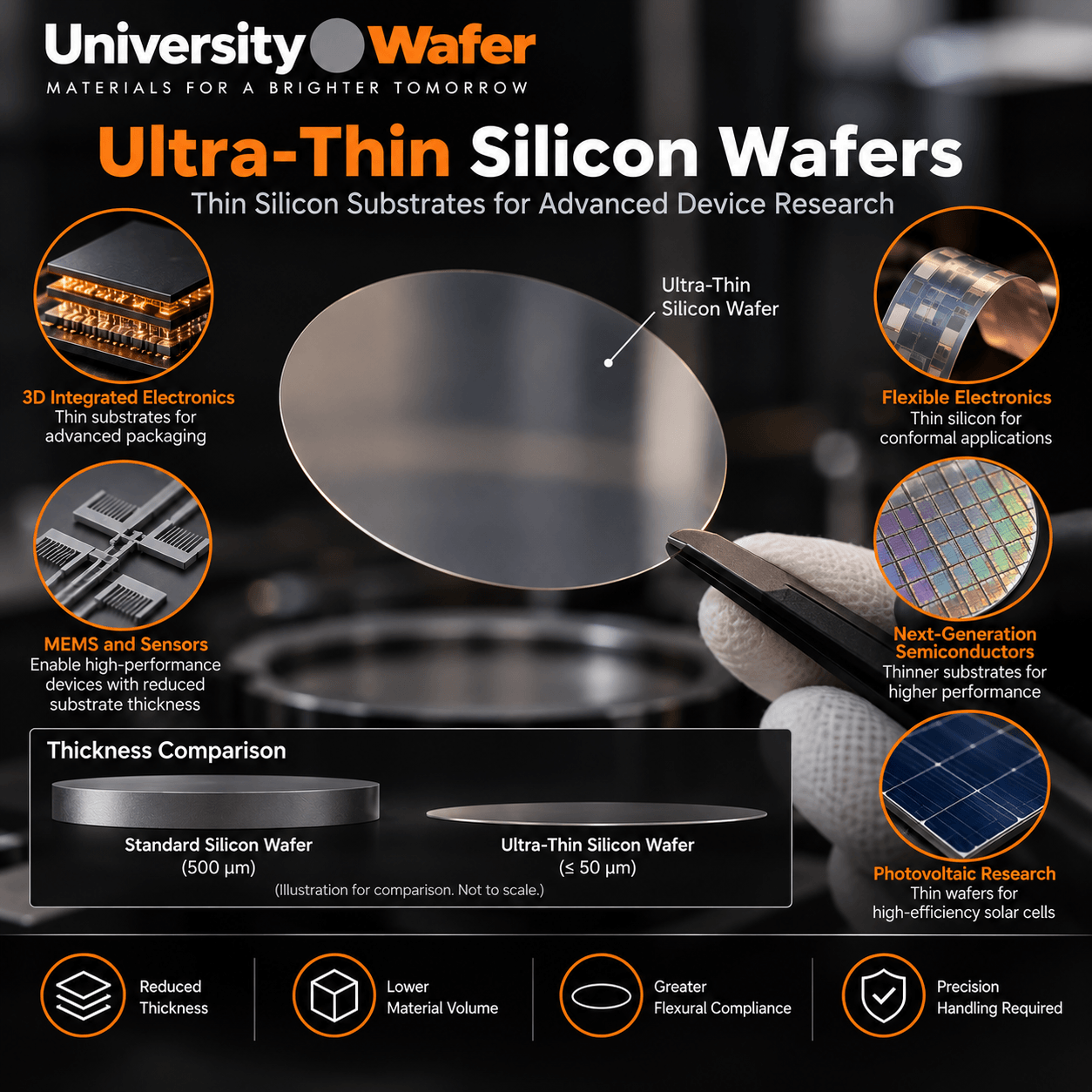
Ultra-thin silicon wafers are essential substrates for next-generation semiconductor devices, MEMS fabrication, AI processors, power electronics, sensors, and 3D integrated circuits. Typically ranging from 5–100 µm thick, these precision-engineered wafers reduce electrical resistance, improve thermal performance, and enable smaller, lighter, and more energy-efficient electronic devices.
Researchers worldwide use ultra-thin silicon wafers for advanced applications including electric vehicles, renewable energy, high-speed computing, wearable electronics, and flexible semiconductor devices.
Need Ultra-Thin Silicon Wafers? Buy Online or request a custom quotation for your exact wafer diameter, thickness, orientation, dopant, and surface finish.
Why Researchers Choose Ultra-Thin Silicon Wafers
Ultra-thin silicon substrates help engineers improve device performance while reducing size and weight. Their excellent electrical characteristics and compatibility with modern semiconductor fabrication processes make them ideal for developing advanced integrated circuits, MEMS devices, high-speed processors, sensors, and next-generation power electronics.
UniversityWafer supplies research-grade silicon wafers with custom specifications for universities, government laboratories, startups, and semiconductor manufacturers worldwide.
What Are Ultra-Thin Silicon Wafers?
Ultra-thin silicon wafers are precision-engineered silicon substrates typically manufactured between 5 µm and 100 µm thick. Their reduced thickness lowers electrical resistance, improves heat dissipation, and enables the fabrication of smaller, faster, and more energy-efficient semiconductor devices.
These wafers are widely used in advanced semiconductor manufacturing, MEMS fabrication, AI processors, power electronics, sensors, flexible electronics, and next-generation packaging technologies. UniversityWafer supplies ultra-thin silicon wafers in custom diameters, orientations, dopants, resistivities, and polished surface finishes for research and production applications.

Advantages of Ultra-Thin Silicon Wafers
Reducing wafer thickness improves electrical and thermal performance while lowering material consumption. These benefits make ultra-thin silicon an attractive choice for researchers developing high-performance electronic devices.
- Lower electrical resistance
- Improved switching performance
- Excellent thermal management
- Reduced package size and weight
- Higher device integration density
- Compatibility with advanced packaging technologies
- Ideal for MEMS and flexible electronics
Applications of Ultra-Thin Silicon Wafers
Ultra-thin silicon substrates support a wide range of emerging technologies and semiconductor research projects.
- Artificial Intelligence (AI) processors
- Data center power electronics
- MEMS sensors
- 3D integrated circuits (3D IC)
- Power MOSFETs
- Electric vehicle electronics
- Solar cells
- Medical devices
- Flexible electronics
- Internet of Things (IoT) devices
Manufacturing Ultra-Thin Silicon Wafers
Producing ultra-thin silicon wafers requires precision grinding, chemical mechanical polishing (CMP), stress-relief processing, and advanced handling techniques. Modern manufacturing methods produce mirror-polished surfaces with extremely low total thickness variation (TTV), allowing the wafers to be used in demanding semiconductor applications.
Depending on the application, wafers can be supplied with custom thicknesses, orientations, dopant types, resistivity ranges, oxide coatings, and single-side or double-side polished surfaces.
Common Specifications
| Property | Information |
|---|---|
| Typical Thickness | 5–100 µm |
| Advanced Thickness | Approximately 20 µm on 300 mm wafers |
| Surface Finish | Mirror polished (1–2 nm RMS roughness) |
| Total Thickness Variation (TTV) | Less than 1 µm |
| Electrical Improvement | Up to 50% lower substrate resistance |
| Power MOSFET Performance | Up to 40% lower RDS(on) |
| Applications | AI, MEMS, EVs, Solar Cells, 3D ICs, IoT |