
A PhD candidate requested single-crystal ZnS substrates with <111> orientation and 0.3 mm thickness for two-photon and three-photon absorption experiments. The researcher also requested ZnO crystals for comparison studies.
UniversityWafer supplies zinc sulfide (ZnS) wafers, single-crystal substrates, polished optical blanks, and multispectral ZnS windows for infrared imaging, spectroscopy, and photonics research. Specify a size, thickness, orientation, and surface finish to match your experiment. Compare other materials in our infrared substrate guide.
Zinc Sulfide (ZnS) Wafers for Nonlinear Optical Research
Single-crystal ZnS substrates support nonlinear optics and multiphoton absorption studies. For a related II-VI material used in nonlinear and terahertz experiments, compare zinc telluride (ZnTe) substrates. For two-photon or three-photon absorption experiments, researchers can specify crystal orientation and thickness, then evaluate the polished faces and optical performance at the intended wavelength.

Reference #96178 for specs and pricing.
Get Your ZnS Quote Fast! Share your dimensions, quantity, orientation, polish, and wavelength requirements below. Or buy available wafers online and start researching today.
ZnS Wafers for Optical Components
Optical-grade ZnS is used for infrared optical windows, lenses, spectroscopy, and multispectral imaging components. See our electro-optic components for related windows, lenses, and prisms. Specify the wavelength band, window diameter, thickness, and scratch-dig finish when requesting a polished ZnS blank. Multispectral ZnS is an option when both visible and infrared transmission are required.
An aeronautical engineer requested undoped optical-grade ZnS substrates for infrared applications.
UniversityWafer supplied:
- Diameter: 38.1 ±0.1 mm
- Thickness: 2 ±0.1 mm
- Double-side polished
- 60/40 scratch-dig finish
- Optical-grade ZnS
Reference #100020 for pricing.
ZnS Substrates for CO₂ Laser Windows
ZnS and zinc selenide (ZnSe) windows are evaluated for infrared laser optics. ZnSe is commonly selected for CO₂ lasers near 10.6 µm; the appropriate ZnS grade and coating depend on the laser wavelength, power, and optical design.
An engineering student requested inexpensive ZnS and ZnSe blanks to fabricate a CO₂ laser system.
Reference #108479 for specs and pricing.
Semi-Insulating ZnS Wafers
Semi-insulating, double-side polished ZnS crystals can be requested for photonic and detector experiments. Researchers comparing II-VI materials can review ZnS, ZnSe, ZnTe, and CdS substrate applications. Specify the resistivity requirement alongside the orientation, dimensions, and surface finish; confirm availability for the requested grade.
A postdoctoral researcher requested a small quantity of semi-insulating ZnS substrates.
UniversityWafer supplied:
- Orientation: (110)
- Size: 10 × 10 × 1 mm
- Double-side polished (DSP)
- Semi-insulating material
Reference #116681 for specs and pricing.
Custom Zinc Sulfide Substrates
Custom ZnS substrates can be specified as round wafers, rectangular windows, or diced pieces. Request single-side polished (SSP) or double-side polished (DSP) faces, a particular crystal orientation, and a scratch-dig grade as needed. For a broader materials comparison, see II-VI semiconductor substrates.
Zinc Sulfide Sphalerite Substrates
Zinc sulfide can occur in the cubic sphalerite phase or the hexagonal wurtzite phase. For single-crystal ZnS wafers, specify the phase and crystallographic orientation required by your optical or electronic experiment. Optical-grade multispectral windows may have different specifications from oriented single-crystal pieces.
A postdoc requested sphalerite ZnS wafers and asked for available sizes, orientations, polishing options, and pricing.
Reference #103087 for specs and pricing.
What Are Sphalerite Wafers?
A sphalerite ZnS wafer is a single-crystal zinc sulfide substrate with a cubic crystal structure. This differs from hexagonal wurtzite ZnS. Researchers can request an oriented piece, such as (110) or (111), when crystal direction matters for an experiment.
- Material: Cubic ZnS (sphalerite), when specified
- Applications: Infrared optics, spectroscopy, and crystal studies
- Surface finish: SSP, DSP, or a specified scratch-dig grade
- Research use: nonlinear optics, transmission experiments, and thin-film coating research
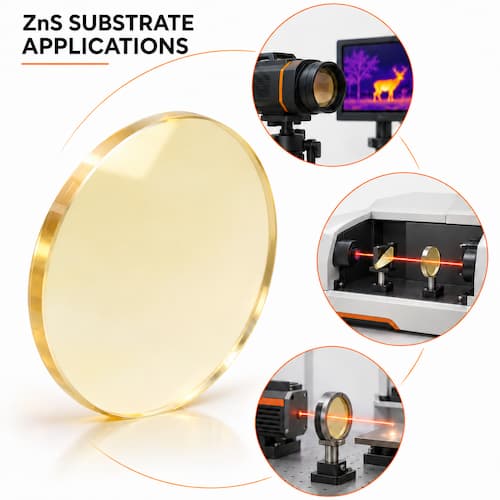
What Are Zinc Sulfide (ZnS) Substrates Used For?
ZnS substrates are used for infrared transmission and optical-material research. Select the material grade and finish for your wavelength range and application:
- Infrared windows: ZnS is used for IR optics, lenses, protective windows, and polished blanks.
- Laser optics: Compare ZnS with ZnSe wafers and windows for the target wavelength and power.
- Detector research: ZnS crystals may be evaluated for optoelectronic and UV-sensitive device studies.
- Electroluminescent devices: ZnS is a common host material for light-emitting phosphors.
- Coating research: ZnS windows can be evaluated with optical coatings chosen for the operating band.
- Photonics: Polished ZnS can be used for optical transmission and nonlinear optics studies; compare related optoelectronic substrate applications.
ZnS Substrates Transmissive in the Visible
Researchers request multispectral zinc sulfide windows when both visible and infrared transmission are required. They can compare substrate requirements for infrared spectroscopy and imaging systems. Specify the optical grade, wavelength band, scratch-dig quality, surface polish, and thickness. Ask for a transmission specification for the precise grade and wavelength range before selecting an optical component.
- Visible and infrared transmission
- Multispectral ZnS options
- Optical-grade polishing
- Custom sizes and thicknesses
- Scratch-dig requirements such as 60/40 polish
ZnS Crystal and Multispectral Window Inventory
The examples below list ZnS crystals, polished (110) pieces, and multispectral optical windows by size, finish, and listed quantity. Request current availability and pricing before ordering; inventory may change. Include the row number and required wavelength or inspection criteria with your quote request.
| # | Type | Size | Orientation / Finish | Qty Available |
|---|---|---|---|---|
| 1 | Random oriented | 6×4×2 mm | All sides 60/40 polished | 25 pcs |
| 2 | Multispectral window | Ø13×0.5 mm | — | 6 pcs |
| 3 | Multispectral window | 4×4×20 mm | 4×20 mm sides 60/40 polished | 9 pcs |
| 4 | (110) | 10×5×5 mm | 5×5 sides // (110), 60/40 polished; other sides fine grinded | 3 pcs |
| 5 | Multispectral window | Ø17×2 mm | Center hole Ø1 mm | 1 pc |
| 6 | Multispectral window | Ø17×2 mm | Center hole Ø1.5 mm | 1 pc |
| 7 | Multispectral window | Ø17×2 mm | Center hole Ø2 mm | 1 pc |
| 8 | Multispectral window | Ø8×5 mm | — | 6 pcs |
| 9 | (110) | Diam. 10×1 mm | 2 sp., clear aperture 8.5 mm | 1 pc |
| 10 | Multispectral blank | Ø25.4×1 mm | (110), inspection polished | 1 pc |
| 11 | (110) | Ø10×0.3 mm | Polished 60/40 | 1 pc |
| 14 | (110) | 10×10×0.5 mm | 1 side 60/40 polished, 1 side fine grinded | 4 pcs |
| 15 | (110) | 5×5×1 mm | 2 sides 60/40 polished | 29 pcs |
| 16 | (110) | 10×10×0.5 mm | 2 sides 60/40 polished | 21 pcs |
| 17 | (110) | Ø10×2 mm | 2 sides 60/40 polished | 1 pc |
| 18 | Multispectral window | Ø10×2 mm | 2 sides 60/40 polished | 2 pcs |
| 19 | (110) | 10×10×2 mm | 2 sides 60/40 polished | 6 pcs |
| 20 | (110) | 10×10×0.1 mm | 2 sides 60/40 polished | 2 pcs |
| 21 | (110) | Diam. 25.4×2 mm | 2 sp., clear aperture 23 mm | 1 pc |
| 22 | Multispectral window | Diam. 17×2 mm | 2 sp. | 2 pcs |
| 23 | (110) | 5×5×1 mm | 1 side grinded, 1 side cleaved surface | 6 pcs |
| 24 | (110) | 10×10×0.5 mm | 2 sp., 99.995% purity | 11 pcs |
| 25 | (110) | 6×4×2 mm | All sides polished; (111) plane at 45° to 6 mm side | 4 pcs |
| 26 | (110) | 20×10×1 mm | 2 sp. | 1 pc |
| 27 | (110) | 10×10×0.25 mm | 2 sp. | 3 pcs |
| 28 | (110) | 5×5×0.5 mm | 2 sp. | 19 pcs |
| 29 | (110) | 5×5×0.25 mm | 2 sp. | 2 pcs |
ZnS Substrate Questions
What are zinc sulfide wafers used for?
ZnS wafers and optical windows are used in infrared imaging, spectroscopy, laser optics, and research on optical and semiconductor materials.
What crystal structures does ZnS occur in?
Zinc sulfide can occur as cubic sphalerite or hexagonal wurtzite. Specify the crystal phase when ordering a single-crystal ZnS substrate.
What specifications should I provide for a ZnS substrate quote?
Provide the required size, thickness, crystal orientation or optical grade, surface polish, quantity, and operating wavelength where applicable.
What is the difference between ZnS and ZnSe optical windows?
Both are II-VI materials used in infrared optics. Multispectral ZnS is often selected for visible-to-infrared windows, while ZnSe is commonly selected for CO₂ laser optics. Confirm transmission and coating requirements for the intended wavelength.
Related Optical and II-VI Materials
- Zinc selenide (ZnSe) wafers and IR windows
- Zinc oxide (ZnO) single-crystal substrates
- Cadmium sulfide (CdS) wafers
- II-VI semiconductor materials
- Optical windows and infrared substrates
- Infrared spectroscopy substrates
- Electro-optic windows and lenses
- Zinc telluride (ZnTe) substrates
- Thin-film coating substrates