Understanding Carrier Concentration in Semiconductor Wafers
Carrier concentration is the number of mobile electrons or holes
per unit volume in a semiconductor and is typically expressed in
cm-3. It is an important electrical parameter because, together with
carrier mobility, it determines the electrical conductivity and resistivity of
semiconductor material.
Semiconductor conductivity can be expressed as:
σ = q(nμn + pμp)
where q is the elementary charge, n and
p are the electron and hole concentrations, and
μn and μp are the corresponding carrier
mobilities.
In materials such as
silicon,
gallium phosphide (GaP),
gallium arsenide (GaAs),
and
silicon carbide (SiC),
equilibrium carrier concentration depends on factors including
doping, temperature, band structure, band-gap energy, dopant ionization,
compensation, and defects.
In an intrinsic semiconductor, the equilibrium electron and
hole concentrations are equal:
n = p = ni
The intrinsic carrier concentration depends strongly on temperature and band-gap
energy. For example, crystalline silicon has an intrinsic carrier concentration
on the order of 1010 cm-3 at 300 K, whereas GaP has a much
lower intrinsic carrier concentration because its band gap is substantially
larger.
In a doped semiconductor, the actual electron and hole concentrations generally
differ from ni. Donor and acceptor dopants change the majority-carrier
population, while compensation and incomplete dopant ionization can also affect
the measured free-carrier concentration.
UniversityWafer, Inc. supplies semiconductor substrates with specified electrical
and physical properties such as carrier concentration, resistivity, conductivity
type, orientation, thickness, and surface finish for research and device
development.
Get Your Carrier Concentration Wafer Quote FAST!
Or,
Buy Wafers Online
and Start Researching Today!
Gallium Phosphide (GaP) Carrier Concentration Specifications
Researchers may require
gallium phosphide (GaP)
substrates with specified electrical properties for optoelectronics,
semiconductor-device research, photonics, and epitaxial growth.
GaP is an indirect-band-gap III-V semiconductor with a
room-temperature band gap of approximately 2.26 eV.
Its intrinsic carrier concentration at 300 K is extremely low, so the
electrical properties of practical GaP wafers are usually governed much more
strongly by electrically active dopants, compensation, defects, and impurities
than by intrinsic carrier generation.
One researcher requested the following epi-ready 2-inch GaP wafers:
High-Resistivity / Semi-Insulating GaP
- Diameter: 2 inches
- Orientation: (100)
- One-side polished
- Thickness: 300–350 µm
- Requested carrier concentration: < 1 × 1015 cm-3
- Quantity: 10 wafers
N-Type GaP
- Diameter: 2 inches
- Orientation: (100)
- One-side polished
- Thickness: 300–350 µm
- Requested electron concentration: ≥ 1 × 1018 cm-3
- Quantity: 10 wafers
The researcher also requested a single evaluation wafer to assess substrate
quality before ordering the full quantity.
Important: carrier concentration and dopant concentration are
related but are not necessarily identical. The number of electrically active free
carriers can differ from the chemical dopant concentration because of factors such
as incomplete ionization, compensation, defects, and temperature.
Likewise, a semi-insulating wafer should be characterized primarily
by its very high electrical resistivity and low free-carrier conductivity rather
than by a carrier-concentration value alone.
Reference #264285 for specifications and pricing.
Why Does Carrier Concentration Matter?
Carrier concentration helps determine the electrical behavior of a semiconductor,
but it must be considered together with carrier mobility, resistivity, band
structure, device geometry, and operating temperature.
By controlling donor or acceptor doping, engineers can tailor the majority-carrier
concentration for particular device regions. Different applications may require
very different carrier concentrations.
-
Low free-carrier concentration / high resistivity:
useful for electrically isolating substrates, detector structures, RF devices,
and other applications where substrate conduction must be minimized.
-
Moderate doping:
commonly used to form controlled n-type and p-type regions in transistors,
diodes, sensors, and photovoltaic devices.
-
Heavy doping:
can be used to reduce contact or series resistance and create highly conductive
semiconductor regions, although very high doping can also reduce mobility and
alter recombination and band-structure behavior.
Carrier concentration therefore plays an important role in applications including:
- Transistors and integrated circuits
- LEDs and laser diodes
- Solar cells
- Photodetectors
- MEMS devices
- Power electronics
- RF and microwave components
- Radiation detectors
- Sensors and biosensors
- Optoelectronic devices
How Is Carrier Concentration Measured?
One of the most common methods for measuring carrier concentration in semiconductor
wafers is the Hall effect. A Hall measurement can provide the
majority-carrier type, Hall carrier concentration, and Hall mobility when the
appropriate sample geometry and measurement conditions are used.
Combining carrier-concentration and mobility measurements also allows researchers
to evaluate electrical conductivity and resistivity. Other electrical and optical
techniques may be used depending on the semiconductor, doping level, layer
thickness, and device structure.
Semiconductor Materials Available with Electrical Specifications
UniversityWafer supplies a range of semiconductor materials that may be specified
by conductivity type, resistivity, carrier concentration, dopant, and related
electrical properties, subject to current inventory and manufacturing capability.
What Is Carrier Concentration in Semiconductors?
Carrier concentration is the number of mobile charge carriers
per unit volume in a semiconductor and is typically expressed in
cm-3. Electrons in the conduction band and holes in the valence
band can both contribute to electrical conduction.
Electron concentration is commonly represented by n, while
hole concentration is represented by p. Carrier concentration
is an important semiconductor property because, together with
carrier mobility, it determines electrical conductivity:
σ = q(nμn + pμp)
where q is the elementary charge,
μn is electron mobility, and
μp is hole mobility.
Carrier concentration depends on factors including
temperature, doping, dopant ionization, compensation, defects,
and the semiconductor's electronic band structure.
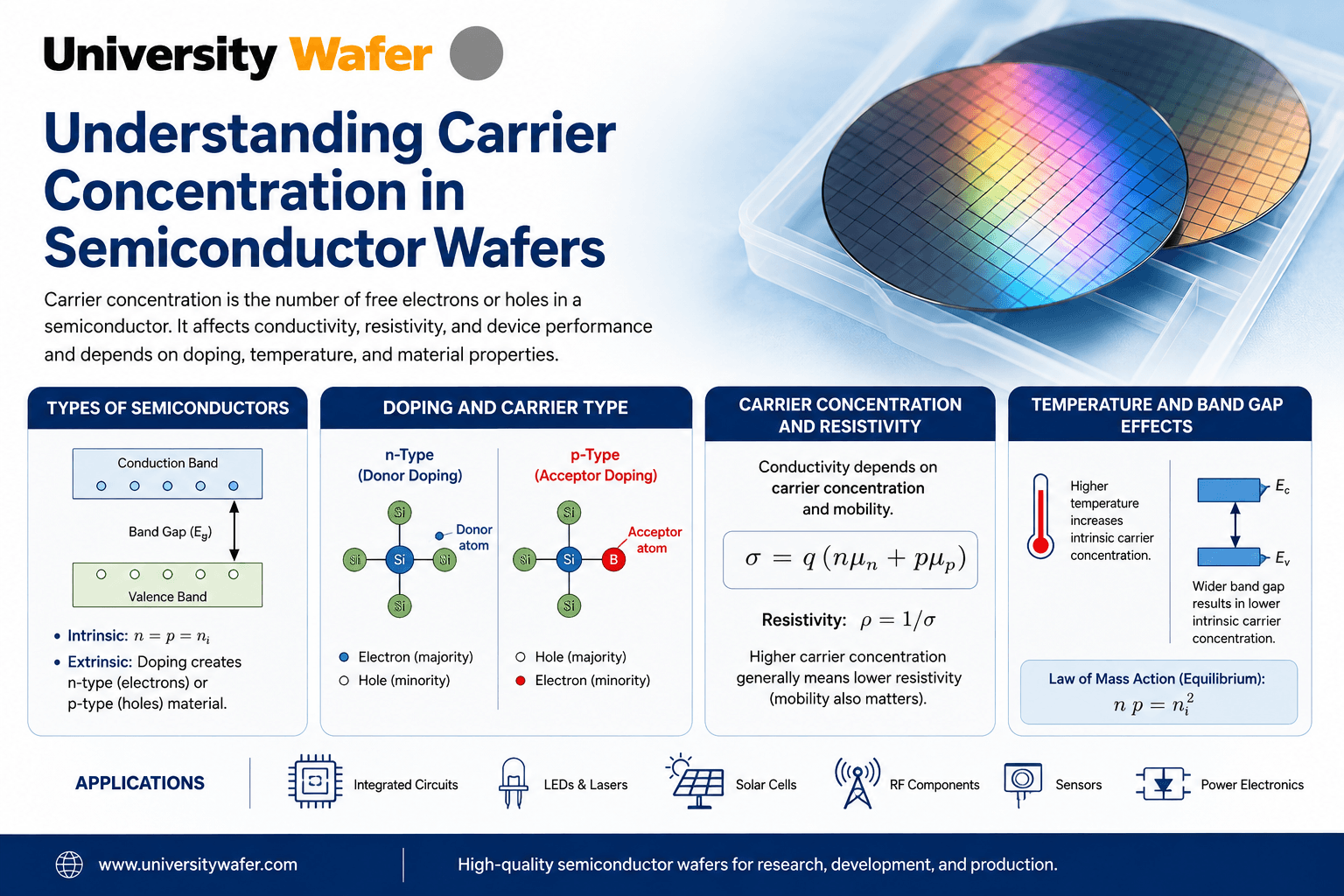
Intrinsic and Extrinsic Semiconductors
An intrinsic semiconductor is an ideally pure or sufficiently
uncompensated semiconductor in which the equilibrium electron and hole
populations are governed primarily by thermal generation rather than intentional
doping.
At thermal equilibrium in an intrinsic semiconductor:
n = p = ni
where ni is the intrinsic carrier concentration.
An extrinsic semiconductor has intentionally introduced
donor or acceptor dopants that modify the equilibrium electron and hole
concentrations.
-
Intrinsic carrier concentration (ni):
The equilibrium electron concentration, which is equal to the equilibrium
hole concentration, in an intrinsic semiconductor at a specified temperature.
-
Majority carriers:
The more abundant carrier type in an extrinsic semiconductor under the
conditions being considered.
-
Minority carriers:
The less abundant carrier type in an extrinsic semiconductor.
In ordinary n-type material, electrons are the majority carriers and holes are
the minority carriers. In ordinary p-type material, holes are the majority
carriers and electrons are the minority carriers.
How Does Doping Change Carrier Concentration?
Doping is the controlled introduction of electrically active
impurities into a semiconductor to modify its carrier concentrations and
electrical properties.
In silicon, group-V elements such as phosphorus, arsenic, and
antimony can act as donor dopants. Donors can provide electrons to
the conduction band, producing n-type material.
Group-III elements such as boron can act as acceptor dopants
in silicon. Acceptors increase the hole concentration, producing p-type
material.
Dopant concentration and free-carrier concentration are not always
identical. Their relationship depends on dopant ionization,
compensation, temperature, defects, and doping level. At sufficiently high
doping levels, semiconductor behavior can also become degenerate.
Carrier Concentration and Resistivity
Carrier concentration and resistivity are closely related, but carrier
concentration alone does not determine resistivity. Resistivity is the
reciprocal of conductivity:
ρ = 1 / σ
= 1 / [q(nμn + pμp)]
Therefore, both carrier concentration and carrier mobility
must be considered.
Increasing the majority-carrier concentration often reduces resistivity,
but heavy doping can also reduce carrier mobility because of increased
ionized-impurity scattering. The relationship is therefore not perfectly
proportional across all doping levels.
Carrier concentration and resistivity specifications are important when
selecting wafers for applications such as:
- Integrated circuits and CMOS devices
- MEMS fabrication
- Power electronics
- Solar cells
- Photonic and optoelectronic devices
- RF and microwave components
- Sensors and detectors
The Law of Mass Action in Semiconductors
Under thermal equilibrium, a nondegenerate semiconductor can be described
by the law of mass action:
np = ni2
Here, n is the equilibrium electron concentration,
p is the equilibrium hole concentration, and
ni is the intrinsic carrier concentration at the same temperature.
This relationship shows that increasing the equilibrium concentration of
one carrier type through ordinary doping generally decreases the equilibrium
concentration of the other carrier type.
The simple relationship np = ni2 applies under
thermal equilibrium and nondegenerate semiconductor conditions.
More complete statistical treatments are required for strongly degenerate
materials or systems driven significantly out of equilibrium.
What Determines Intrinsic Carrier Concentration?
For a nondegenerate intrinsic semiconductor, the intrinsic carrier
concentration can be written approximately as:
ni =
√(NCNV)
exp[-Eg/(2kBT)]
where:
-
NC = effective density of states in the
conduction band
-
NV = effective density of states in the
valence band
-
Eg = band-gap energy
-
kB = Boltzmann constant
-
T = absolute temperature
This relationship explains why intrinsic carrier concentration is
strongly temperature dependent and why semiconductor
materials with larger band gaps generally have much lower intrinsic carrier
concentrations at a given temperature, all else being comparable.
How Does Temperature Affect Carrier Concentration?
Temperature has a strong effect on carrier populations, but the behavior
should be distinguished between intrinsic and doped semiconductors.
In an intrinsic semiconductor, increasing temperature
generates more electron-hole pairs by thermal excitation, causing
ni to increase rapidly.
A doped semiconductor can exhibit several temperature regimes:
-
Freeze-out region:
At sufficiently low temperature, some dopants are not ionized, so the
free-carrier concentration can be relatively low.
-
Extrinsic region:
Over an intermediate temperature range, dopants are substantially ionized
and the majority-carrier concentration is governed mainly by doping and
compensation.
-
Intrinsic region:
At sufficiently high temperature, thermally generated electron-hole pairs
become comparable to or exceed the dopant-generated carrier population.
The temperatures associated with these regimes depend on the semiconductor
material, dopant species, doping concentration, compensation, and band
structure.
How Does Band Gap Affect Intrinsic Carrier Concentration?
The
band gap
strongly influences intrinsic carrier concentration.
At a given temperature, a smaller band gap generally allows thermal
excitation of electron-hole pairs more readily and therefore results in
a higher intrinsic carrier concentration. A larger band gap generally
results in a much lower intrinsic carrier concentration.
This is one reason wide-band-gap semiconductors such as
silicon carbide (SiC)
and gallium nitride (GaN) can maintain very low intrinsic carrier
concentrations at temperatures where narrower-band-gap semiconductors
experience much stronger intrinsic carrier generation.
Band gap alone, however, does not determine the actual
conductivity of a doped wafer. Doping, mobility, compensation, defects,
and temperature must also be considered.
Carrier Concentration in Solar Cells
Carrier concentration is an important design parameter in photovoltaic
devices, but maximum solar-cell efficiency is not achieved simply by
maximizing the number of carriers.
Controlled doping is used to establish junctions, built-in electric
fields, contact regions, and other device structures. Doping concentration
also affects properties such as recombination, minority-carrier lifetime,
mobility, junction behavior, and series resistance.
Solar-cell design therefore requires balancing
carrier concentration, carrier lifetime, mobility, recombination,
optical absorption, junction design, and contact resistance.
How Is Carrier Concentration Measured?
The Hall effect is widely used to characterize carrier
concentration in semiconductor materials. Hall measurements can provide
information about majority-carrier type, Hall carrier concentration, and
Hall mobility when the appropriate measurement model and sample conditions
are satisfied.
Resistivity measurements can be combined with Hall measurements to obtain
a more complete picture of a wafer's electrical properties.
Depending on the semiconductor and device structure, other techniques may
also be used to characterize doping or carrier distributions.
Applications That Depend on Carrier Concentration
Controlled carrier concentrations are important throughout semiconductor
technology, including:
- Integrated circuits
- Transistors and MOSFETs
- Diodes and junction devices
- LEDs and laser diodes
- Solar cells
- Photodetectors
- MEMS devices
- RF and microwave electronics
- Power semiconductors
- Radiation detectors
- Sensors and biosensors
- Optoelectronic devices
Carrier Concentration Specifications for Research Wafers
UniversityWafer, Inc. supplies semiconductor substrates with electrical
specifications that can include conductivity type, dopant,
resistivity, and carrier concentration, depending on the material
and available product.
Materials used for semiconductor research include silicon, gallium
phosphide, gallium arsenide, germanium, silicon carbide, gallium nitride,
indium phosphide, and other compound semiconductor substrates.
When selecting a wafer, researchers should distinguish between
chemical dopant concentration, electrically active dopant
concentration, free-carrier concentration, and resistivity.
These quantities are related, but they are not interchangeable.
Related Semiconductor & Carrier Concentration Topics
