
Bonded SOI Wafers for P-Type Silicon Solar Cells
Researchers use bonded silicon-on-insulator (SOI) wafers to fabricate thin p-type silicon solar cells with controlled device-layer thickness, electrical isolation, and mechanical support. SOI wafers are especially useful when the active silicon layer must be thin, uniform, and suitable for photovoltaic testing.
For this solar cell project, the customer requested p-type silicon device layers from 10 µm to 100 µm on an SOI wafer. The target was a low sheet resistance of approximately 200 Ohm/sq or less, while also maintaining high minority carrier lifetime. This balance is important because lower resistance can improve current collection, but excessive doping may reduce carrier lifetime and solar cell efficiency.
The preferred doping level was approximately 1017 cm-3 or lower, although higher doping may be acceptable for very thin silicon solar cells. In this type of research, wafer resistivity, sheet resistance, silicon thickness, and dopant concentration all affect device performance.
SOI Wafer Specs Requested
- Application: P-type silicon solar cell fabrication
- Substrate: Bonded SOI wafer
- Device layer: 10 µm to 100 µm silicon
- Target sheet resistance: Maximum 200 Ohm/sq
- Doping: Low boron-doped p-type silicon preferred
- Research focus: Minority carrier lifetime and photovoltaic performance
Because some SOI wafers have broad resistivity ranges, researchers may ask whether the resistivity can be narrowed before ordering. A tighter resistivity range helps estimate sheet resistance more accurately and improves repeatability during solar cell fabrication.
SOI Items of Interest
The customer was interested in the following bonded SOI wafer items for p-type silicon solar cell research:
- 1000.005502
- 1000.369701
- 1000.509101
- 1000.491401
- 1000.533201
- 1000.516002
- 1000.427201
Get Your P-Type Silicon Solar Cell Wafer Quote FAST! Or, Buy Silicon Wafers Online and Start Researching Today!
How to Fabricate P-Type Silicon Solar Cells
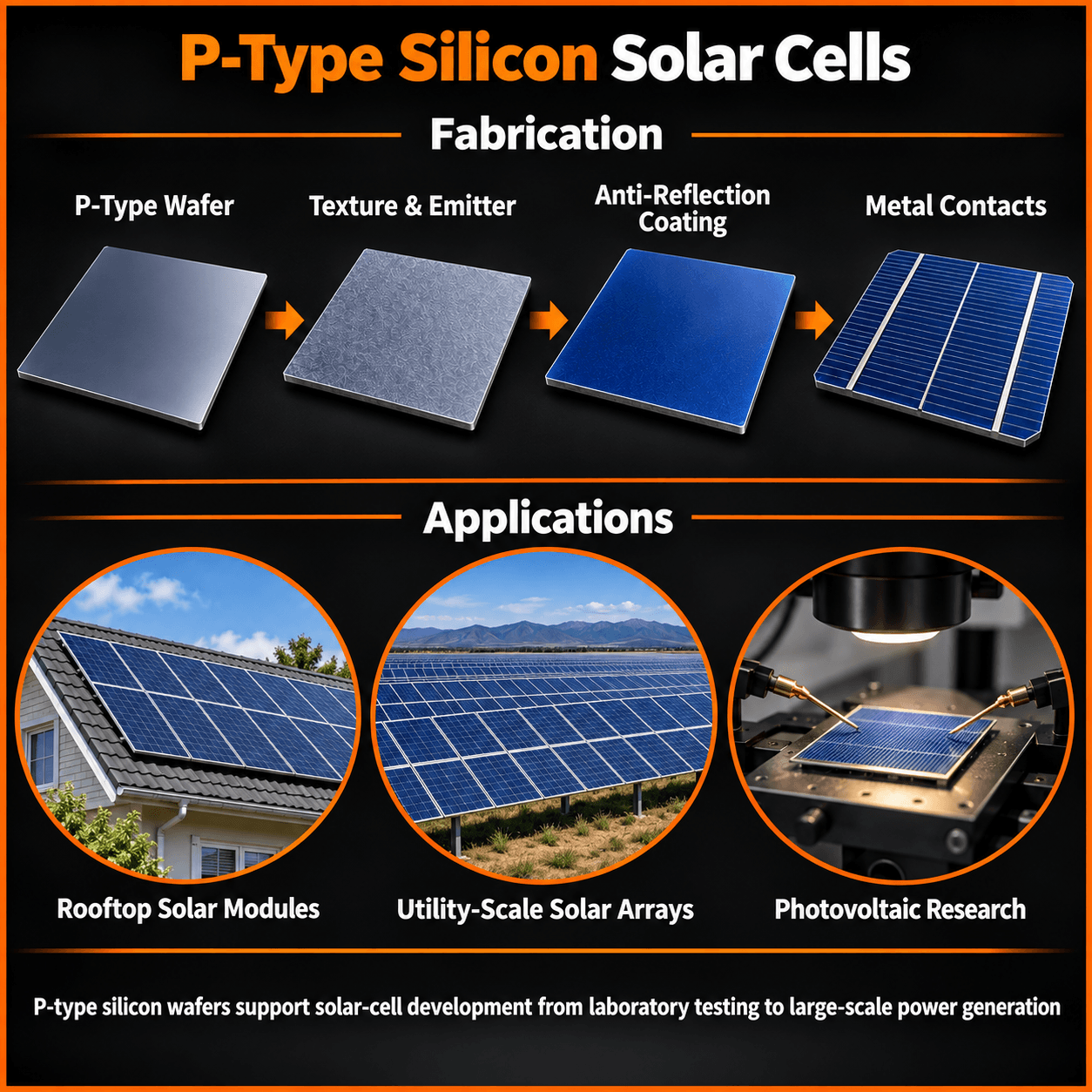
P-type silicon solar cells are commonly fabricated using boron-doped silicon wafers. Boron creates positive charge carriers, or holes, which allow the wafer to function as the p-type base layer in a photovoltaic device. Researchers often use silicon wafers, bonded SOI wafers, and custom doped substrates to study solar cell efficiency, minority carrier lifetime, sheet resistance, and thin-film photovoltaic performance.
For thin p-type silicon solar cells, the active silicon layer thickness is an important design parameter. Researchers may request device layers from approximately 10 µm to 100 µm thick, depending on the solar cell structure, absorption requirements, and fabrication process. Silicon-on-insulator wafers are useful for this work because the buried oxide layer can help define the silicon thickness and provide electrical isolation during processing.
Important Wafer Specs for P-Type Solar Cell Research
When selecting wafers for p-type silicon solar cell fabrication, researchers often compare several specifications:
- Dopant: Boron-doped silicon is typically used for p-type substrates.
- Resistivity: Lower resistivity can help reduce sheet resistance, but very heavy doping may reduce minority carrier lifetime.
- Thickness: Thin silicon layers are useful for advanced photovoltaic structures and SOI-based solar cells.
- Orientation: Common orientations include <100> and <111>, depending on the process and device design.
- Polish: Prime-grade or double-side polished wafers may be preferred for photolithography, deposition, and bonding steps.
Why Sheet Resistance Matters
Sheet resistance is important because it affects how efficiently current moves through the solar cell. A wafer with very high sheet resistance may limit device performance, while a wafer that is too heavily doped can reduce carrier lifetime. For this reason, many research groups request p-type silicon wafers with a controlled resistivity range that balances conductivity and photovoltaic efficiency.
Bonded SOI Wafers for Thin Silicon Solar Cells
Bonded SOI wafers are often used when researchers need a precise silicon device layer over a buried oxide. This makes them useful for fabricating thin silicon solar cells, test structures, photodiodes, and other semiconductor devices. The handle wafer provides mechanical support, while the top silicon layer can be processed into the active photovoltaic region.
UniversityWafer, Inc. supplies silicon substrates, SOI wafers, and custom wafer specifications for photovoltaic research, solar cell development, and semiconductor device fabrication. Researchers can request wafers by diameter, thickness, dopant type, resistivity, orientation, oxide thickness, and polish.
Related Silicon Wafer Resources
- Bonded Silicon-on-Insulator (SOI) Wafers
- Research-Grade Silicon Wafers
- Solar Cell Silicon Wafers
- Silicon-on-Insulator (SOI) Wafers
- P-Type Silicon Wafers
- N-Type Silicon Wafers
- Silicon Epitaxial Wafers
- Thermal Oxide Silicon Wafers
- Silicon Wafer Orientation Guide
- Carrier Concentration in Silicon Wafers