What Substrates Are Used For Polaritonic Research?
Polaritonic research explores the interaction between light and matter to develop next-generation photonic, quantum, and optoelectronic devices. Researchers commonly use substrates such as silicon carbide (SiC), gallium arsenide (GaAs), gallium nitride (GaN), graphene, and gold-coated wafers to investigate exciton-, phonon-, and plasmon-polaritons for applications in nanophotonics, infrared optics, terahertz imaging, quantum computing, and low-power polariton lasers.
6H-SiC Wafers for Surface Phonon-Polariton Research
Researchers investigating surface phonon-polaritons (SPhPs) frequently use 6H silicon carbide (6H-SiC) because of its excellent infrared optical properties and ability to support strongly confined phonon-polariton modes. These substrates are widely used in nanophotonics, terahertz optics, infrared spectroscopy, and quantum photonics research.
The following request was submitted by a Ph.D. researcher studying the optical properties of surface phonon-polaritons.
Research Request
"I am a Ph.D. student in the Department of Electrical Engineering conducting research on the optical properties of surface phonon-polaritons in polar materials such as 6H-SiC.
I am looking for approximately 2-inch, semi-insulating 6H-SiC wafers for optical applications. Could you please provide a formal quotation?"
Typical Research Specifications
- Material: 6H Silicon Carbide (SiC)
- Diameter: 2 inch (50.8 mm)
- Application: Surface phonon-polariton research
- Optical Grade / Semi-Insulating
- Reference #: 224406
Get Your 6H-SiC Quote FAST! Or,
Buy Online and Start Researching Today!
What Are Polaritons?
A polariton is a quasiparticle created when a photon strongly couples with a material excitation, such as an exciton, phonon, or plasmon. Because polaritons combine the properties of both light and matter, they enable unique optical phenomena that are difficult to achieve with photons or electrons alone.
Researchers study polaritons to develop ultra-fast photonic devices, low-power lasers, quantum technologies, terahertz components, and nanoscale optical circuits.
Types of Polaritons
Exciton-Polaritons
Exciton-polaritons are formed when photons couple with excitons (bound electron-hole pairs) inside semiconductor microcavities. These quasiparticles are commonly investigated using GaAs, GaN, and ZnO substrates.
- Polariton lasers
- Quantum optics
- Bose-Einstein condensates
- Integrated photonic circuits
Phonon-Polaritons
Phonon-polaritons occur when photons interact with optical phonons in polar crystals. Materials such as 6H-SiC, 4H-SiC, h-BN, and GaN are widely used because they support strong phonon resonances in the infrared and terahertz spectral regions.
- Infrared optics
- Terahertz imaging
- Nanoscale light confinement
- Surface phonon-polariton devices
Plasmon-Polaritons
Surface plasmon-polaritons (SPPs) result from coupling photons with collective oscillations of electrons at a metal-dielectric interface. Common materials include gold-coated wafers, silver films, and graphene substrates.
- Biosensors
- Plasmonic waveguides
- Nanophotonics
- Surface-enhanced spectroscopy
Why Are Polaritons Important?
Because polaritons combine the speed of light with the strong interactions of matter, they offer significant advantages for next-generation optical technologies. Compared with conventional electronic devices, polariton-based systems can operate with lower power consumption and extremely fast response times.
Potential applications include:
- Quantum computing
- Quantum communication
- Polariton lasers
- Nonlinear optics
- Integrated photonic circuits
- Infrared spectroscopy
- Terahertz imaging
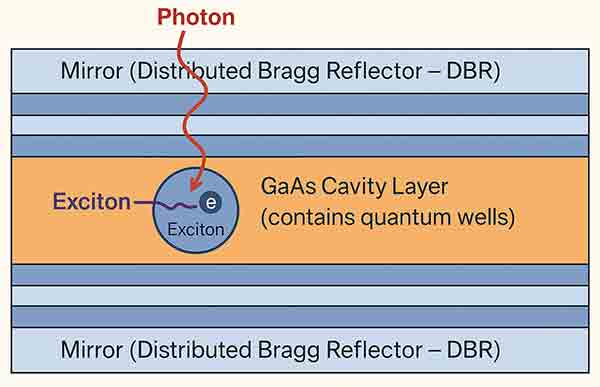
How Exciton-Polaritons Are Formed
In a semiconductor microcavity, photons are confined between highly reflective distributed Bragg reflectors (DBRs). Quantum wells located inside the cavity generate excitons when illuminated. When the photon energy closely matches the exciton energy, the two become strongly coupled, forming exciton-polaritons.
This hybrid quasiparticle exhibits:
- Light-like properties for rapid propagation.
- Matter-like properties that enable interactions and condensation.
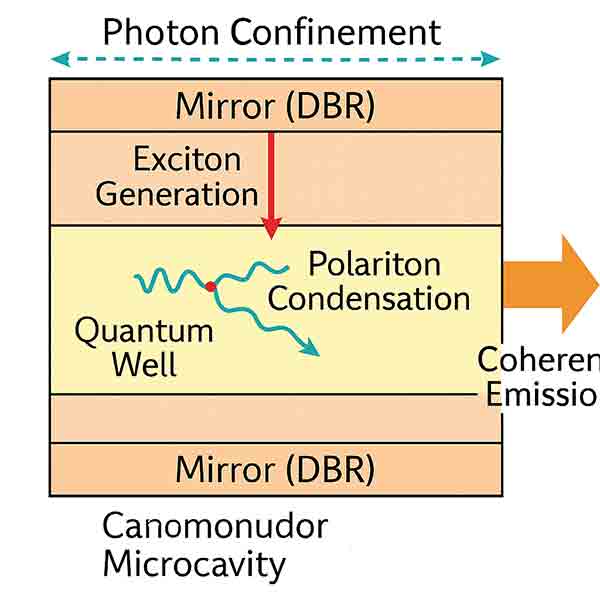
Polariton Lasers
Unlike conventional semiconductor lasers, polariton lasers do not require population inversion. Instead, coherent light is generated through the Bose-Einstein condensation of exciton-polaritons, resulting in significantly lower threshold power.
Advantages include:
- Very low operating power
- High efficiency
- Room-temperature operation in materials such as GaN
- Compatibility with integrated photonic devices
Common Materials for Polaritonic Research
| Polariton Type |
Typical Materials |
Applications |
| Exciton-Polaritons |
GaAs, GaN, ZnO |
Polariton lasers, quantum optics |
| Phonon-Polaritons |
SiC, h-BN |
Infrared optics, THz devices |
| Plasmon-Polaritons |
Gold, Silver, Graphene |
Plasmonics, biosensing, nanophotonics |
Related Research Materials
