
Researcher question: We need silicon wafers with about 2µm of oxide film to form a SiO2 structure on silicon pillars through etching. Will silicon wafer resistivity or dopant type affect the quality of the grown thermal oxide?
Can Silicon Pillars Improve Solar Cell Efficiency?
Improving solar cell efficiency remains one of the primary goals of photovoltaic research. While modern solar cells continue to achieve higher conversion efficiencies, researchers are exploring advanced surface structures such as silicon pillars, silicon micropillars, and silicon nanostructures to capture more sunlight and reduce optical losses.
Silicon pillar arrays fabricated on silicon wafers can significantly improve light trapping by reducing surface reflection and increasing the amount of light absorbed within the semiconductor material. These structures create multiple internal reflections that help photons remain in the solar cell longer, increasing the probability of energy conversion.
Another advantage of silicon pillar structures is their increased surface area and junction area. This geometry can improve carrier collection and enhance the performance of experimental photovoltaic devices, photodetectors, and other optoelectronic systems.
Researchers have also investigated radially doped silicon pillars, which combine efficient light absorption with optimized charge carrier transport. These structures show promise for next-generation solar cells, high-efficiency photonic devices, and advanced semiconductor technologies.
For many silicon pillar fabrication projects, researchers use thermal oxide-coated silicon wafers that can be patterned and etched into precise microstructures. One commonly requested substrate is:
UniversityWafer Silicon Item #783 — 100mm P-Type Boron Doped <100> Silicon Wafer, 1-10 Ω·cm, 500µm Thick, Single-Side Polished, Prime Grade.
These wafers are suitable for silicon pillar research, thermal oxidation, lithography, deep reactive ion etching (DRIE), MEMS fabrication, photonic devices, and solar energy applications.
Get Your Quote FAST! Or, Buy Online and Start Researching Today!
Silicon Wafers for Fabricating Silicon Pillars
Silicon wafers with thermal oxide are commonly used to fabricate silicon pillars, silicon micropillars, SiO2 structures, and patterned silicon surfaces for semiconductor research, solar cell development, MEMS, sensors, and optoelectronic devices.
A researcher requested silicon wafers with approximately 2 microns of thermal oxide for forming SiO2 structures on silicon pillars through etching. For this type of work, wafer orientation, oxide thickness, surface finish, resistivity, and dopant type can all be important depending on the final device design.
UniversityWafer, Inc. Answer: In most cases, dopant type and resistivity do not significantly affect the visible morphology or general quality of thermal oxide grown on silicon wafers. Even heavily doped wafers can produce usable oxide layers. However, for many research projects, we recommend lightly doped boron silicon wafers such as Si:B <100> with 1-100 Ω·cm resistivity.
Commonly used item:
Si Item #783 – 100mm P/B <100> 1-10 Ω·cm, 500µm SSP Prime Grade Silicon Wafer
What Are Silicon Pillars?
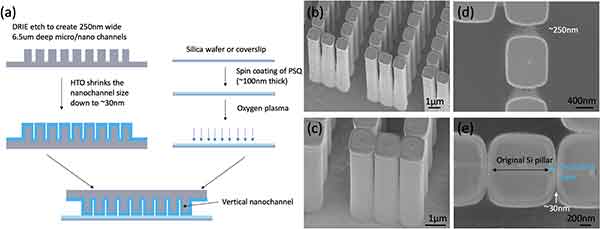
Silicon pillars are vertical microstructures or nanostructures fabricated on a silicon wafer surface. They can be formed by lithographic patterning, thermal oxidation, plasma etching, deep reactive ion etching (DRIE), or other semiconductor microfabrication processes.
Silicon pillars are used to increase surface area, control light interaction, create patterned surfaces, support three-dimensional cell culture, and improve device performance in optical, electronic, and biological applications.
How Silicon Pillars Improve Solar Cell Research
Silicon pillar structures are studied for advanced solar cell and photovoltaic applications because they can reduce optical reflection and increase the junction area available for light absorption. A patterned silicon surface can trap more incident light through multiple reflections between the pillars.
Higher light absorption can help improve the performance of experimental solar cells, photodetectors, and other optoelectronic devices. This makes silicon micropillars and nanopillars useful for research involving renewable energy, photonics, and semiconductor device design.
Thermal Oxide and SiO2 Structures on Silicon Pillars
Thermal oxide silicon wafers are frequently used when researchers need a controlled SiO2 layer for masking, insulation, etching, or surface passivation. A 2µm SiO2 film can serve as an important structural or protective layer during silicon pillar fabrication.
Thermal oxide can help provide:
- Etch masking during silicon microfabrication
- Electrical insulation between device layers
- Surface passivation for silicon structures
- Controlled SiO2 thickness for research devices
- Improved process repeatability for patterned wafers
Silicon Pillar Fabrication Methods
Silicon pillars are often fabricated using a combination of patterned silicon wafers, lithography, oxide masking, and etching. Depending on the required pillar height, diameter, spacing, and sidewall profile, researchers may use dry etching, wet etching, DRIE, or oxidation-based processes.
Important wafer specifications may include:
- Wafer diameter
- Crystal orientation, such as <100>
- Resistivity range
- Dopant type, such as boron or phosphorus
- Thermal oxide thickness
- Single-side polished or double-side polished finish
- Total thickness variation and surface roughness
Applications of Silicon Pillars
Silicon pillars and silicon micropillar arrays are used in many research and engineering applications, including:
- Solar cell efficiency research
- Optoelectronic devices
- MEMS and microsensors
- Photonic structures
- Biomedical devices
- 3D cell culture platforms
- Surface texturing and light trapping
- Microfluidic and lab-on-chip research
UniversityWafer supplies silicon wafers, thermal oxide wafers, and custom substrate specifications for researchers developing silicon pillar structures and patterned semiconductor devices.