Researcher Request:
Could you please provide pricing for 30mm <100> heavily doped silicon wafers (P/B acceptable) with 2850 Angstrom dry thermal oxide? Also, what is the minimum order quantity?
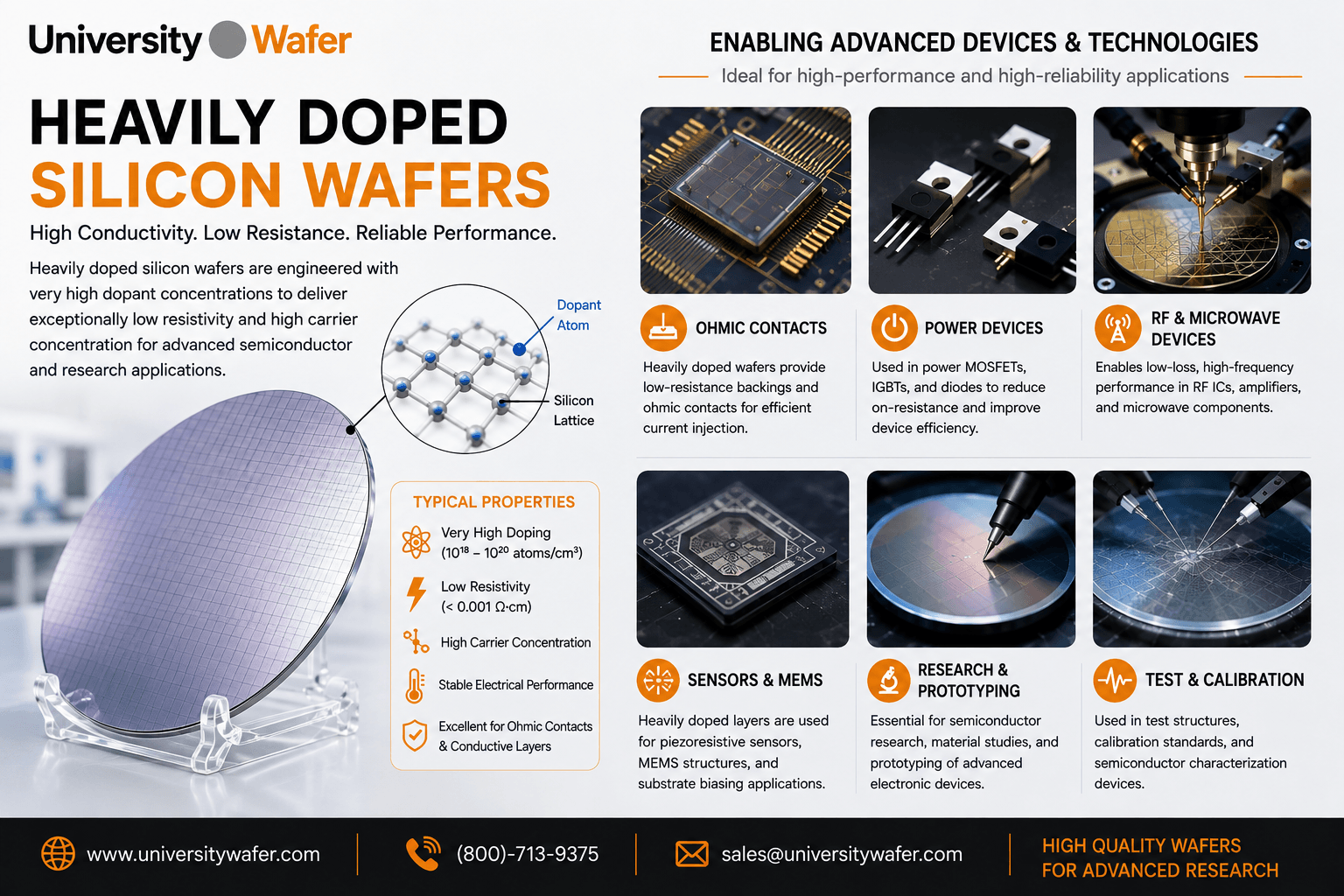
Heavily doped silicon wafers are specialized low-resistivity substrates used in semiconductor device fabrication, MEMS manufacturing, RF electronics, power devices, and solar cell research. By introducing high concentrations of dopants such as boron, phosphorus, arsenic, or antimony, researchers can precisely control electrical conductivity, carrier concentration, and device performance. These silicon wafers are commonly specified with thermal oxide coatings, custom crystal orientations, and ultra-low resistivity values for advanced semiconductor process development and electronic device prototyping.

Heavily doped silicon wafers are widely used in semiconductor research, MEMS fabrication, RF electronics, power devices, sensors, and advanced materials studies. Their low resistivity and high carrier concentration make them ideal for applications requiring excellent electrical conductivity, oxide growth, and reliable device performance.
A PhD researcher recently requested the following heavily doped silicon wafer specification for device fabrication and testing:
Researcher Request:
Could you please provide pricing for 30mm <100> heavily doped silicon wafers (P/B acceptable) with 2850 Angstrom dry thermal oxide? Also, what is the minimum order quantity?
Reference #211189 for specifications, pricing, and availability.
UniversityWafer, Inc. supplies heavily doped silicon wafers in multiple diameters, resistivity ranges, orientations, and oxide thicknesses for research and production applications.
Researchers frequently request custom wafer specifications including:
We can also provide wafers with custom oxide thicknesses, resistivity ranges, crystal orientations, and diameters for semiconductor process development, MOS structures, MEMS devices, RF circuits, and power electronics research.
Get Your Heavily Doped Silicon Wafer Quote FAST! Or, Buy Online and Start Researching Today!
Heavily doped silicon wafers are low-resistivity silicon substrates used when high electrical conductivity, controlled doping, and reliable device performance are required. These wafers are commonly used in semiconductor device manufacturing, MEMS fabrication, RF devices, solar cells, power electronics, sensors, and advanced research applications.
By adding dopants such as boron, phosphorus, arsenic, or antimony, silicon wafers can be made either P-type or N-type. The dopant concentration controls the wafer’s resistivity, carrier concentration, and electrical behavior.
UniversityWafer, Inc. supplies low-resistivity silicon wafers in multiple diameters, orientations, dopants, thicknesses, and polish options. Common stock includes P-type boron-doped and N-type arsenic-doped wafers with resistivity ranges such as 0.01-0.02 ohm-cm and 0.001-0.005 ohm-cm.
Degenerately doped silicon is silicon that has been doped so heavily that it begins to behave more like a metal than a conventional semiconductor. This occurs when the carrier concentration becomes high enough to create very low resistivity and strong electrical conductivity.
UniversityWafer, Inc. generally considers silicon with resistivity below 0.020 ohm-cm to be degenerately doped. Degenerate silicon is useful when a project requires high carrier density, low contact resistance, and conductive silicon behavior.
Typical Degenerately Doped Silicon Guideline:
P-type silicon may be considered degenerately doped when resistivity is below approximately 0.040 ohm-cm. N-type silicon may be considered degenerately doped when resistivity is below approximately 0.020 ohm-cm. UniversityWafer, Inc. typically classifies degenerately doped silicon as material with resistivity below 0.020 ohm-cm.
Reference #224057 for more information.
Heavily doped silicon wafers are available in both P-type and N-type materials. P-type silicon is commonly doped with boron, while N-type silicon may be doped with phosphorus, arsenic, or antimony. The correct dopant depends on the electrical requirements of the device or experiment.
Researchers often specify wafer diameter, orientation, resistivity, dopant, thickness, polish, and oxide thickness when requesting heavily doped silicon wafers.
Need low-resistivity silicon wafers? Send your required diameter, dopant, orientation, resistivity, thickness, polish, oxide thickness, and quantity for a fast quote.