
We are looking for silicon wafers with very high resistivity (Float Zone silicon) for millimeter-wave applications up to 110 GHz. A resistivity near 30 kohm-cm is required to keep the loss tangent as low as possible. The wafer diameter is also important because it must match the dimensions of the RF circuits.
Float Zone Silicon Wafers for mmWave Applications
High-resistivity Float Zone silicon wafers are commonly used in millimeter-wave (mmWave) devices, RF circuits, sensors, and high-frequency semiconductor research. Float Zone silicon provides very low oxygen content, high purity, and excellent electrical resistivity, making it a strong choice when researchers need to reduce dielectric loss and signal attenuation at frequencies up to 110 GHz and beyond.
An electrical engineer requested a quote for high-resistivity silicon wafers for mmWave RF circuit fabrication:
UniversityWafer, Inc. quoted the following high-resistivity Float Zone silicon wafers:
Item Qty. Description
AZ85. 10 Silicon wafers, per SEMI, P/P 6"Ø × 400 ±25µm
FZ n-type Si:P [100] ±0.5°, Ro > 3,500 Ohm-cm
Both-sides polished, SEMI flat, one.
Reference #122830 for specs and pricing.
Get Your mmWave Silicon Wafer Quote FAST! Or, Buy Online and Start Researching Today!
Intrinsic Silicon Wafers for Millimeter-Wave Particle Accelerator Research
Intrinsic silicon wafers are also used in experimental millimeter-wave research, including externally driven particle accelerator structures, semiconductor switches, and high-power pulsed RF systems. For these applications, wafer thickness, diameter, resistivity, and carrier recombination behavior can strongly influence device performance.
A PhD candidate requested help sourcing intrinsic silicon wafers for millimeter-wave accelerator research:
Do you have in stock any intrinsic silicon wafer with a thickness between 450-475µm and 3 or 4 inches in diameter?
After reading scientific publications, researchers reported a carrier recombination time of about 10ns using silicon wafers supplied by UniversityWafer. This recombination time is suitable for my experiment. Is this time value still valid in the silicon wafer currently offered? Do you also have information about carrier recombination time in gold-implanted germanium (Ge:Au) and gold-implanted silicon (Si:Au)?
The research references include a laser-driven semiconductor switch for generating nanosecond pulses from a megawatt gyrotron and an experimental demonstration of an externally driven millimeter-wave particle accelerator structure.
Reference #267041 for specs and pricing.
What Are mmWave Devices?
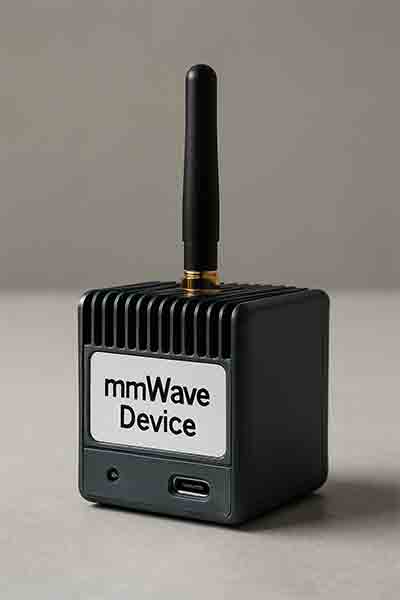
Millimeter-wave (mmWave) devices operate in the electromagnetic spectrum between 30 GHz and 300 GHz, corresponding to wavelengths from 1 mm to 10 mm. These ultra-high-frequency devices are critical components in 5G and emerging 6G wireless communications, automotive radar, satellite communications, advanced sensing systems, and high-speed data transmission. Their ability to deliver low latency, extremely high bandwidth, and precise signal resolution makes them essential for next-generation semiconductor technologies.
Common Applications of mmWave Devices
Millimeter-wave technology enables wireless systems that require extremely high data rates and reliable signal transmission. Typical applications include:
- 5G and future 6G wireless infrastructure
- Automotive radar for adaptive cruise control, collision avoidance, and autonomous vehicles
- Satellite communications and aerospace systems
- High-speed point-to-point wireless networks
- Airport security scanners and imaging equipment
- Medical diagnostics and biomedical sensing
- Industrial automation, robotics, and smart manufacturing
- Military and defense radar systems
What Substrates Are Used to Fabricate mmWave Devices?
The performance of mmWave integrated circuits, antennas, RF filters, power amplifiers, and sensors depends heavily on the electrical and mechanical properties of the substrate. The best mmWave substrates provide:
- Low dielectric constant
- Very low dielectric loss tangent
- Excellent thermal conductivity
- High resistivity
- Superior surface flatness
- Excellent dimensional stability
- Compatibility with advanced semiconductor fabrication processes
Gallium Arsenide (GaAs)
Gallium arsenide (GaAs) offers extremely high electron mobility, making it one of the preferred materials for microwave and millimeter-wave integrated circuits. GaAs substrates are commonly used for:
- Monolithic Microwave Integrated Circuits (MMICs)
- Low Noise Amplifiers (LNAs)
- RF switches
- High-frequency transceivers
- Satellite communications
Gallium Nitride on Silicon Carbide (GaN-on-SiC)
GaN-on-SiC wafers combine the high power capability of gallium nitride with the exceptional thermal conductivity of silicon carbide. They are widely used for:
- 5G base stations
- Radar transmitters
- Defense electronics
- Power amplifiers
- Electronic warfare systems
High-Resistivity Silicon
Float Zone (FZ) high-resistivity silicon wafers are commonly selected for mmWave circuits because they minimize dielectric losses while remaining compatible with standard CMOS manufacturing. They are widely used in:
- RF integrated circuits
- mmWave sensors
- 5G smartphones
- Internet of Things (IoT) devices
- Integrated antennas
Silicon Germanium (SiGe)
Silicon germanium combines the manufacturing advantages of silicon with improved carrier mobility, making it an excellent material for BiCMOS mmWave circuits, low-noise receivers, and high-speed communication systems.
Indium Phosphide (InP)
Indium phosphide provides exceptional electron velocity and supports frequencies well above 100 GHz. It is widely used in:
- Ultra-high-speed photonics
- Terahertz research
- Optical communications
- Scientific instrumentation
Quartz and Fused Silica
Quartz and fused silica substrates exhibit extremely low dielectric loss, making them excellent choices for passive millimeter-wave components including:
- Waveguides
- Filters
- Delay lines
- High-frequency antennas
- Optical and RF components
Silicon-on-Insulator (SOI)
SOI wafers reduce parasitic capacitance and substrate losses while improving RF isolation. These substrates are frequently used for:
- RF front-end modules
- Integrated mmWave antennas
- Low-power RF electronics
- 5G communication chipsets
Important Properties When Selecting a mmWave Substrate
| Property | Importance |
|---|---|
| Dielectric Constant (εr) | Determines impedance matching and signal propagation. |
| Loss Tangent (tanδ) | Lower values reduce insertion loss and improve efficiency. |
| Thermal Conductivity | Removes heat generated by high-power RF devices. |
| Surface Flatness | Supports advanced lithography and wafer bonding. |
| Lattice Matching | Improves epitaxial growth quality and device reliability. |
| Electrical Resistivity | Reduces RF substrate losses in high-frequency circuits. |
UniversityWafer Supplies Substrates for mmWave Research
UniversityWafer supplies research laboratories, universities, government agencies, and semiconductor manufacturers with substrates optimized for millimeter-wave and RF device fabrication. Available materials include:
- High-resistivity Float Zone silicon wafers
- GaAs wafers
- GaN-on-SiC substrates
- Silicon-on-Insulator (SOI)
- Quartz substrates
- Single crystal quartz
- Fused silica wafers
- Sapphire wafers
- Custom substrate orientations, polishing, and thicknesses
Whether you are developing 5G components, RF integrated circuits, millimeter-wave sensors, automotive radar, or terahertz devices, UniversityWafer offers high-quality research substrates with custom specifications to meet your project requirements.
Related mmWave & High-Frequency Substrate Resources
- Float Zone Silicon Wafers
- Silicon Wafers
- Silicon-on-Insulator (SOI) Wafers
- Gallium Arsenide (GaAs) Wafers
- Silicon Carbide (SiC) Substrates
- Gallium Nitride (GaN) Wafers
- Single Crystal Quartz Wafers
- Fused Silica Wafers
- Semiconductor Device Manufacturing
- Terahertz Circuit Substrates
- HEMT GaN Wafers
- Integrated Photonics Substrates