
We are developing a graphene field-effect transistor (GFET) sensor for biosensing applications and require high-quality graphene on a silicon substrate with excellent surface uniformity and compatibility with photolithography and microfabrication processes. Which graphene substrate would you recommend?
Get Your Graphene Sensor Substrate Quote FAST!
UniversityWafer supplies high-quality graphene substrates for graphene sensors, graphene field-effect transistors (GFETs), biosensors, gas sensors, chemical sensors, wearable electronics, MEMS devices, and semiconductor research.
Whether you are developing a proof-of-concept device or scaling up production, our technical team can help you select the ideal graphene substrate based on your application, fabrication process, and performance requirements.
Researcher Request
Buy as few as one substrate for research and development. Buy Online or request a custom quotation below.
Popular Graphene Sensor Substrates
- Graphene on Si/SiO₂
- CVD Graphene
- Monolayer Graphene
- Bilayer and Multilayer Graphene
- Graphene on Sapphire
- Graphene on Quartz
- Custom Graphene Research Substrates
Common Research Applications
- Graphene biosensors
- Graphene field-effect transistors (GFETs)
- Gas sensors
- Chemical sensors
- Pressure and strain sensors
- Wearable medical devices
- Microfluidic biosensors
- MEMS and NEMS devices
- Semiconductor device fabrication
- Flexible electronics
Why UniversityWafer?
UniversityWafer supplies research-grade graphene substrates in small and bulk quantities for universities, government laboratories, startups, and commercial manufacturers. Our materials support advanced research in biosensing, nanoelectronics, photonics, and next-generation semiconductor devices.
What Is a Graphene Sensor?
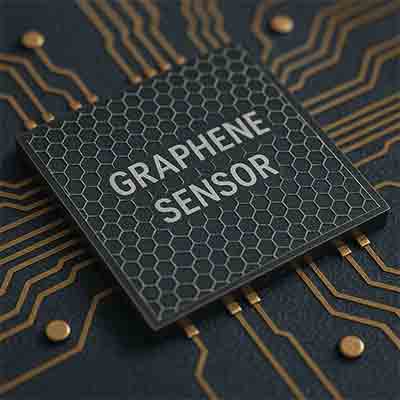
A graphene sensor is an advanced sensing device that uses one or more layers of graphene to detect changes in its surrounding environment. Because graphene is only one atom thick and has exceptional electrical, mechanical, and thermal properties, even the smallest interaction with molecules can produce measurable electrical signals. This makes graphene one of the most promising materials for next-generation biosensors, chemical sensors, gas sensors, wearable electronics, and environmental monitoring systems.
Researchers frequently fabricate graphene sensors on silicon wafers, silicon dioxide (SiO2), sapphire, and other semiconductor substrates using standard microfabrication techniques that are compatible with CMOS processing.
How Does a Graphene Sensor Work?
Graphene sensors operate by monitoring changes in graphene's electrical conductivity, resistance, capacitance, or current after molecules interact with its surface. Since every atom in graphene is exposed, the material is extremely sensitive to chemical and biological events that occur at the atomic level.
When gases, proteins, DNA strands, viruses, or other target molecules attach to the graphene surface, they modify the material's electronic properties. These changes are detected and converted into electrical signals that can be analyzed by external electronics.
Why Researchers Choose Graphene
Compared with traditional sensing materials, graphene offers numerous advantages for semiconductor and biosensing research.
- Extremely high electron mobility
- Large surface area for molecular detection
- Excellent electrical conductivity
- Low electrical noise
- High mechanical strength
- Flexible and transparent
- Fast response times
- Low power consumption
- Excellent thermal conductivity
- Compatibility with MEMS and CMOS fabrication
Graphene Field-Effect Transistor (GFET) Sensors
One of the most common graphene sensor designs is the Graphene Field-Effect Transistor (GFET). In a GFET, graphene serves as the conductive channel between the source and drain electrodes. When target molecules bind to the graphene surface, they alter the carrier concentration, shifting the transistor's electrical characteristics.
GFET sensors offer excellent sensitivity while requiring very little power, making them ideal for portable diagnostic devices, wearable electronics, and real-time monitoring systems.
Common Types of Graphene Sensors
| Sensor Type | Typical Applications |
|---|---|
| Graphene Biosensors | DNA, RNA, proteins, viruses, glucose detection |
| Gas Sensors | Hydrogen, methane, ammonia, NO₂, CO₂ monitoring |
| Chemical Sensors | Industrial process monitoring and environmental testing |
| Pressure Sensors | Medical devices and wearable electronics |
| Strain Sensors | Structural health monitoring and robotics |
| Humidity Sensors | Climate control and environmental monitoring |
| Temperature Sensors | Electronic packaging and industrial automation |
Graphene Biosensors
Graphene biosensors are among the fastest-growing areas of nanotechnology research. Their ultra-high sensitivity allows scientists to detect extremely small concentrations of biological molecules without fluorescent labels or complex sample preparation.
Current research focuses on detecting:
- DNA and RNA sequences
- Cancer biomarkers
- Proteins and enzymes
- Antibodies
- Viruses and bacteria
- Glucose
- Hormones
- Neural electrical signals
Graphene on Silicon Substrates
Many graphene devices are fabricated on silicon wafers with a silicon dioxide (SiO₂) layer. Silicon provides excellent mechanical stability while remaining compatible with semiconductor manufacturing techniques including photolithography, thin-film deposition, plasma etching, wafer bonding, and MEMS fabrication.
Researchers often select silicon substrates because they allow graphene devices to be integrated alongside conventional CMOS electronics, enabling compact sensor systems with onboard signal processing.
Applications of Graphene Sensors
Graphene sensors are being developed across numerous scientific and industrial fields.
- Medical diagnostics
- Point-of-care testing
- Cancer detection
- Virus identification
- Environmental monitoring
- Industrial gas detection
- Food quality monitoring
- Wearable health monitors
- Internet of Things (IoT) devices
- Robotics
- Aerospace monitoring systems
- Autonomous vehicles
- Semiconductor process monitoring
Advantages Compared with Conventional Silicon Sensors
| Feature | Graphene Sensors | Conventional Silicon Sensors |
|---|---|---|
| Sensitivity | Extremely High | Moderate |
| Response Speed | Very Fast | Fast |
| Power Consumption | Low | Higher |
| Flexibility | Flexible Devices Possible | Rigid |
| Surface Area | Very Large | Limited |
| Wearable Electronics | Excellent | Limited |
Current Research Challenges
Despite their impressive performance, graphene sensors still present manufacturing challenges. Producing large-area graphene with consistent quality, minimizing contamination, improving long-term stability, reducing contact resistance, and integrating graphene with existing semiconductor manufacturing remain active research areas.
Researchers continue investigating improved CVD graphene growth, wafer-scale transfer methods, encapsulation techniques, and hybrid graphene-semiconductor devices to improve commercial production.
Graphene Research Substrates Available
UniversityWafer supplies a variety of graphene substrates for universities, national laboratories, and industrial R&D facilities. Available materials include graphene on silicon dioxide, graphene on silicon, CVD graphene, monolayer graphene, multilayer graphene, and custom research substrates designed for sensor development.
Whether your project involves graphene biosensors, GFET devices, gas sensing, MEMS integration, or flexible electronics, our technical team can help you identify the most appropriate substrate for your research requirements.