
“I am looking for a substrate to collect powder samples and transfer them for SEM and AFM analysis. The powders are collected on a 400mm segmented metal disc, with each segment containing less than one milligram of material. What is the lowest-cost solution for preparing and transferring these samples for microscopy?”
Silicon Wafers Used as Sample Holders for SEM and AFM Analysis
Silicon wafers are widely used as sample holders and mounting substrates for Scanning Electron Microscopy (SEM), Atomic Force Microscopy (AFM), thin-film characterization, particle analysis, and materials science research. Their ultra-flat, ultra-clean surfaces make them ideal for supporting powders, nanoparticles, coatings, and micro-scale samples without introducing contamination.
A Materials Scientist Asked the Following:
Get Your Quote FAST! Or, Buy Online and Start Researching Today!
Why Silicon Wafers Are Recommended for SEM Analysis
Silicon wafers are among the most commonly used substrates for microscopy because they combine exceptional cleanliness, flatness, dimensional precision, and affordability. Researchers frequently use semiconductor-grade silicon wafers as sample holders because they do not interfere with imaging, elemental analysis, or surface measurements.
Advantages of silicon wafer sample holders include:
- Ultra-flat surfaces for accurate SEM and AFM measurements
- Extremely low contamination levels
- Compatibility with powders, nanoparticles, and thin films
- Excellent dimensional stability
- Cost-effective compared to many specialty substrates
- Available in custom diced sizes and shapes
Because silicon is highly purified and manufactured under strict semiconductor standards, it provides a reliable platform for material characterization and defect analysis.
Available Silicon Wafer Sizes and Configurations
Silicon wafers are available in diameters ranging from 1 inch to 12 inches and larger. For SEM sample preparation, wafers are frequently diced into smaller pieces to accommodate different sample sizes and microscope stages.
Common sample holder formats include:
- 5mm × 5mm diced chips
- 10mm × 10mm squares
- 20mm × 25mm rectangles
- Circular wafer segments
- Triangular pieces
- Hexagonal or octagonal shapes
- Custom wafer geometries
Researchers may choose either single-side polished (SSP) or double-side polished (DSP) wafers depending on the application and mounting requirements.
Do Electrical Properties Matter for SEM Sample Holders?
For most SEM and AFM applications, the electrical properties of the silicon wafer are not critical. Researchers commonly use both p-type and n-type semiconductor-grade silicon wafers because the primary requirement is a clean, flat support surface rather than specific electrical characteristics.
In most cases:
- Doping type is not important
- Resistivity above 1 ohm-cm is acceptable
- Crystal orientation is not critical
- Standard semiconductor-grade material is sufficient
The main exception is specialized applications such as Powder X-Ray Diffraction (XRD), where crystal orientation may influence experimental results.
Monocrystalline Silicon for Precision Microscopy
All monocrystalline silicon wafers are manufactured with tightly controlled crystal structures and cleanliness standards. Wafers are supplied in sealed cassettes and cleaned using semiconductor-industry procedures to minimize particle contamination.
These characteristics make monocrystalline silicon an excellent substrate for:
- SEM analysis
- AFM imaging
- Particle characterization
- Nanotechnology research
- Thin-film analysis
- Powder sample evaluation
- Materials science investigations
By selecting the proper wafer dimensions, polish type, and dicing configuration, researchers can create cost-effective sample holders tailored to their microscopy requirements.
Reference #213585 for specifications and pricing.
What Substrates Are Used for Scanning Electron Microscopy (SEM)?
Scanning Electron Microscopy (SEM) is one of the most widely used techniques for examining surface morphology, particle size, thin films, microstructures, and material defects. Before SEM imaging can begin, samples must be mounted on a clean, stable substrate that does not interfere with imaging or elemental analysis.
Common substrates used for SEM analysis include:
- Silicon wafers for powders, thin films, nanoparticles, and semiconductor materials
- Aluminum stubs for general-purpose SEM mounting
- Carbon tape for conductive sample attachment
- Glass substrates for biological and optical samples
- Metal grids for nanoparticles and TEM preparation
- Polymer films for specialized non-conductive samples
The best substrate depends on the sample type, imaging requirements, and whether elemental analysis will be performed.
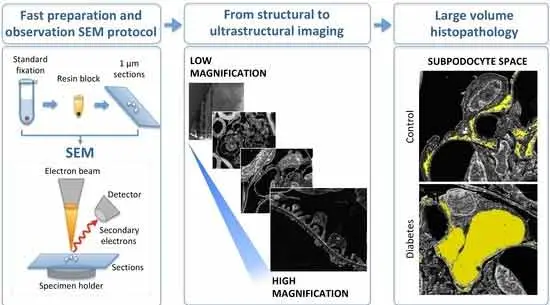
Why Silicon Wafers Are Ideal for SEM Analysis
Silicon wafers are among the most popular substrates for SEM analysis because they provide an ultra-flat, ultra-clean, and highly uniform surface. Their low surface roughness minimizes background artifacts and helps researchers obtain high-resolution SEM images.
Advantages of silicon wafers include:
- Extremely smooth surface finish
- Low contamination levels
- Excellent dimensional stability
- Compatibility with EDS analysis
- Available in multiple diameters and thicknesses
- Easy dicing into custom sample holders
Researchers frequently use silicon wafers to mount powders, nanoparticles, thin films, coatings, MEMS devices, semiconductor structures, and nanomaterials.
SEM Analysis and Material Characterization
SEM analysis provides detailed information about the physical structure and surface characteristics of a material. Modern scanning electron microscopes can achieve nanometer-scale resolution, making them valuable tools for semiconductor manufacturing, nanotechnology research, and materials science.
SEM characterization is commonly used to evaluate:
- Surface morphology
- Particle size distribution
- Thin-film quality
- Microcracks and defects
- Coating thickness
- Grain structure
- Surface contamination
Because SEM imaging provides significantly greater depth of field than traditional optical microscopy, researchers can observe complex three-dimensional structures with exceptional clarity.
Energy Dispersive Spectroscopy (EDS) Analysis
Many SEM systems are equipped with Energy Dispersive Spectroscopy (EDS), which allows researchers to identify the elemental composition of a sample while imaging.
EDS analysis can determine the presence and distribution of elements such as:
- Silicon (Si)
- Oxygen (O)
- Carbon (C)
- Aluminum (Al)
- Titanium (Ti)
- Gold (Au)
- Gallium (Ga)
- Germanium (Ge)
Combining SEM imaging with EDS mapping allows scientists to correlate surface features with chemical composition.
SEM Sample Preparation Best Practices
Proper sample preparation is critical for obtaining high-quality SEM images. Samples should be clean, dry, and securely mounted before entering the microscope chamber.
Typical SEM preparation procedures include:
- Cleaning the sample surface
- Removing dust and contamination
- Mounting with conductive tape or adhesive
- Sputter coating non-conductive materials
- Ensuring compatibility with vacuum conditions
Non-conductive samples are often coated with gold, platinum, carbon, or palladium to reduce charging effects and improve image quality.
Applications of SEM Analysis
SEM analysis is used across a wide range of scientific and industrial disciplines.
- Semiconductor manufacturing
- Failure analysis
- Nanotechnology research
- MEMS characterization
- Materials science
- Battery research
- Biomedical engineering
- Forensic investigations
- Thin-film analysis
- Microelectronics development
Researchers frequently choose silicon wafer substrates because they provide a clean and reliable platform for high-resolution imaging and elemental analysis.
Video: SEM Micrographs and Material Characterization
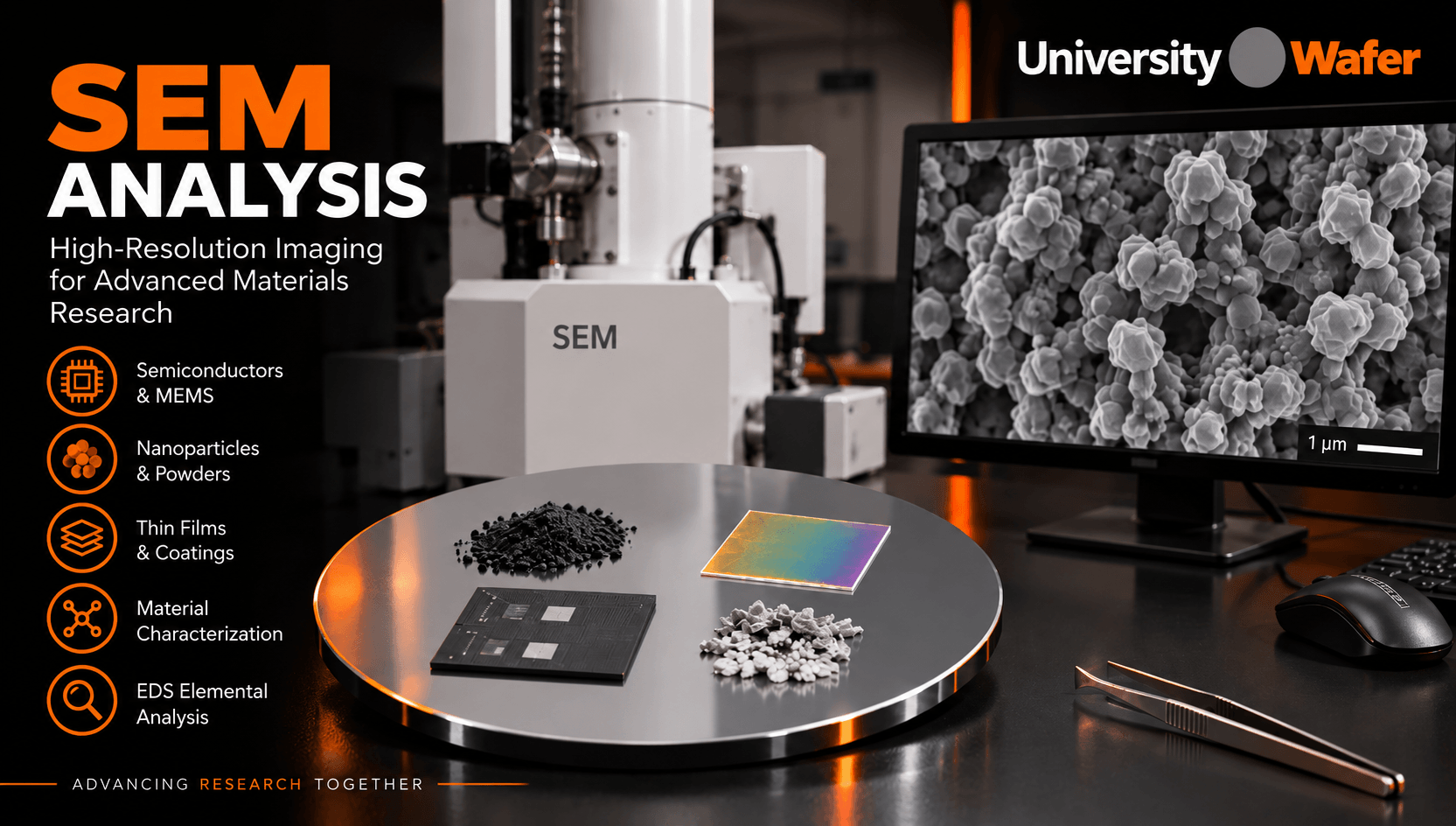
Related SEM Analysis Resources
- Silicon Wafers for SEM Analysis
- Monocrystalline Silicon Wafers
- Double Side Polished Silicon Wafers
- Single Side Polished Silicon Wafers
- Chemical Mechanical Polishing (CMP)
- Ultra Thin Silicon Wafers
- Semiconductor Manufacturing
- MEMS Device Fabrication
- Photolithography Process
- Ellipsometry and Thin Film Analysis
- Semiconductor Material Characterization
- Graphene Research Substrates
- Thermal Oxide Silicon Wafers