
Order Ultra-Thin Silicon Wafers
UniversityWafer helps researchers match thin crystalline silicon to a process. Tell us the final thickness and tolerance, wafer diameter or piece size, p type or n type doping, resistivity, crystal orientation, single side polished (SSP) or double side polished (DSP) finish, TTV and quantity. Specify whether a carrier, ring support or diced pieces are required.
Get Your Quote Fast! Or Buy Silicon Wafers Online and start researching today.
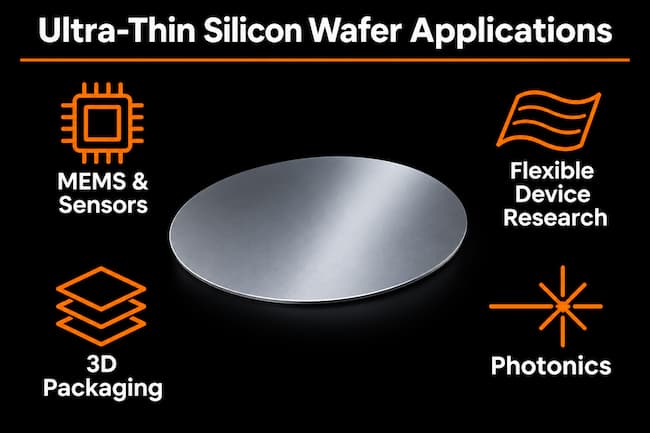
Thin Silicon for MEMS and Sensors
Thin substrates can support membranes, vibrating structures and other silicon MEMS research. An earlier nebulizer study used a 100 mm, undoped, (100), 75 µm DSP silicon wafer for a vibrating mesh. This is an example research specification; verify that thickness, strength and surface requirements suit your own design.
Thin Silicon for Plasma FIB Masks
A researcher asked about 50, 75 and 100 µm DSP silicon wafers in 2 inch and 3 inch diameters for physical masks in xenon plasma focused ion beam work. Mask performance depends on ion energy, aperture geometry, substrate thickness and processing method. Request a current quote for the chosen diameter and thickness.
Silicon Pieces for Carbon Nanotube Research
Another request concerned diced silicon pieces for carbon nanotube growth and optical measurements. The example quoted a 25 mm, p type boron doped, (100), 10 µm DSP silicon substrate. If your experiment needs flexible silicon, ask how the thin piece will be supported and handled; thinner silicon can flex but remains brittle.
What Are Ultra-Thin Silicon Wafers?
An ultra-thin silicon wafer is a crystalline silicon substrate processed to a thickness well below a conventional wafer of the same diameter. Research examples on this page include 5, 10, 25, 50, 75 and 100 µm. A particular thickness is not automatically available in every diameter, dopant, orientation or finish; request the actual specification and lead time.
Ultra-Thin Wafer Thickness and Key Specifications
- Final thickness and tolerance: choose the thickness needed by the device and equipment.
- Total thickness variation (TTV): specify allowable thickness variation across the wafer.
- Bow, warp and surface finish: review flatness, roughness and SSP or DSP requirements for lithography or bonding.
- Diameter, orientation and resistivity: match the wafer to electrical and fabrication needs.
- Handling method: decide whether temporary bonding, a rigid ring or a carrier wafer is needed.
How Are Silicon Wafers Thinned?
Depending on the starting wafer and target specification, a process may combine backside grinding, lapping, stress relief, etching and polishing. Silicon wafer backgrinding removes bulk material; later steps can reduce damage and adjust surface finish and TTV. The process route should be chosen for the finished wafer and its handling requirements.
Handling and Carrier Support
As silicon gets thinner, cracking, bow and handling losses become more important. Temporary wafer bonding to a rigid carrier can support grinding, deposition or lithography before debonding. A rigid support ring may help for some research formats. Plan the handling and release steps before ordering a very thin free-standing wafer.
Thin Silicon vs. Thin Device Layers on SOI
A fully thinned silicon wafer is different from a silicon on insulator (SOI) wafer. SOI has a silicon device layer separated from a handle wafer by a buried oxide. If your design needs a very thin device layer with a robust handle, SOI may be a better specification than a free-standing ultra-thin wafer.
Thin Silicon for Photovoltaic Research
Reducing silicon thickness can lower the amount of material used in a solar cell research substrate, but it can also change light absorption, breakage risk and processing yield. Cell efficiency and cost depend on the full design and manufacturing flow; thickness alone does not guarantee improvement. Researchers studying solar silicon wafers should specify thickness alongside surface texturing, doping and handling needs.
Diamond Wire Sawn and Finished Wafers
A diamond wire sawn (DWS) wafer may have a different surface from a lapped or polished wafer. If the experiment needs an as-sawn surface, say so in the quote; a finished wafer with the same thickness may not be a substitute. State whether you require a round wafer, pseudo-square solar wafer, lapped wafer or polished device substrate.