
Non-Irradiated Sapphire Wafers for XRD and Radiation Studies
Non-irradiated sapphire wafers are widely used as reference substrates for comparing crystal quality before and after irradiation, plasma treatment, ion implantation, or high-temperature processing. Their excellent thermal stability, optical transparency, and chemical resistance make sapphire substrates ideal for X-ray diffraction (XRD), crystal orientation analysis, and GaN epitaxy.
Researchers frequently use C-plane sapphire wafers with controlled off-axis angles to investigate structural changes caused by radiation exposure and to evaluate lattice defects through rocking curve measurements.
Applications of Non-Irradiated Sapphire Wafers
- X-ray diffraction (XRD) analysis
- Rocking curve measurements
- Radiation damage studies
- Ion implantation experiments
- GaN epitaxy and LED fabrication
- High-temperature materials research
- Optical and photonic devices
- Crystal orientation characterization
Why Researchers Use Sapphire Substrates
Sapphire substrates offer excellent mechanical strength, high thermal conductivity, and low chemical reactivity. These properties make sapphire a preferred material for semiconductor devices, laser systems, RF electronics, and optoelectronic applications.
UniversityWafer, Inc. supplies research-grade single-side polished sapphire wafers with various orientations and diameters for universities, laboratories, and production environments.
Get Your Non-Irradiated Sapphire Wafer Quote FAST! Or, Buy Online and Start Researching Today!
Non-Irradiated Sapphire Wafer for XRD and Crystal Orientation Studies
A non-irradiated sapphire wafer is often used as a reference sample when researchers compare the crystal structure, surface quality, and X-ray diffraction results of sapphire before and after irradiation. Sapphire substrates are widely used in materials science, GaN epitaxy, optical devices, LED research, high-temperature applications, and radiation-effect studies.
UniversityWafer, Inc. supplies sapphire wafers for research and production, including C-plane sapphire wafers with controlled off-axis miscut angles.
Example Sapphire Wafer Specification
- Item: Sapphire Wafer Item #1306
- Diameter: 50.8 mm
- Thickness: 430 μm
- Polish: Single Side Polished (SSP)
- Orientation: C-plane (0001)
- Miscut: 0.2 ± 0.1° toward the M-axis
What Does C-Plane Toward M-Plane Mean?
When a sapphire wafer is described as C-plane to M-plane, it means the wafer surface is oriented near the C-plane (0001) but intentionally tilted, or miscut, slightly toward the M-axis. In this example, the sapphire wafer has a small off-axis angle of 0.2 ± 0.1°.
This controlled miscut is commonly used in sapphire substrates because it can influence epitaxial growth behavior, surface step structure, and device-layer uniformity. For researchers comparing irradiated and non-irradiated sapphire, knowing the original wafer orientation is important for accurate XRD and rocking curve analysis.
XRD Data for Non-Irradiated Sapphire Wafers
Researchers often use X-ray diffraction (XRD) to study crystal orientation, lattice quality, and structural changes in sapphire wafers. A non-irradiated sapphire wafer can serve as a baseline reference before irradiation, ion exposure, laser processing, or high-temperature treatment.
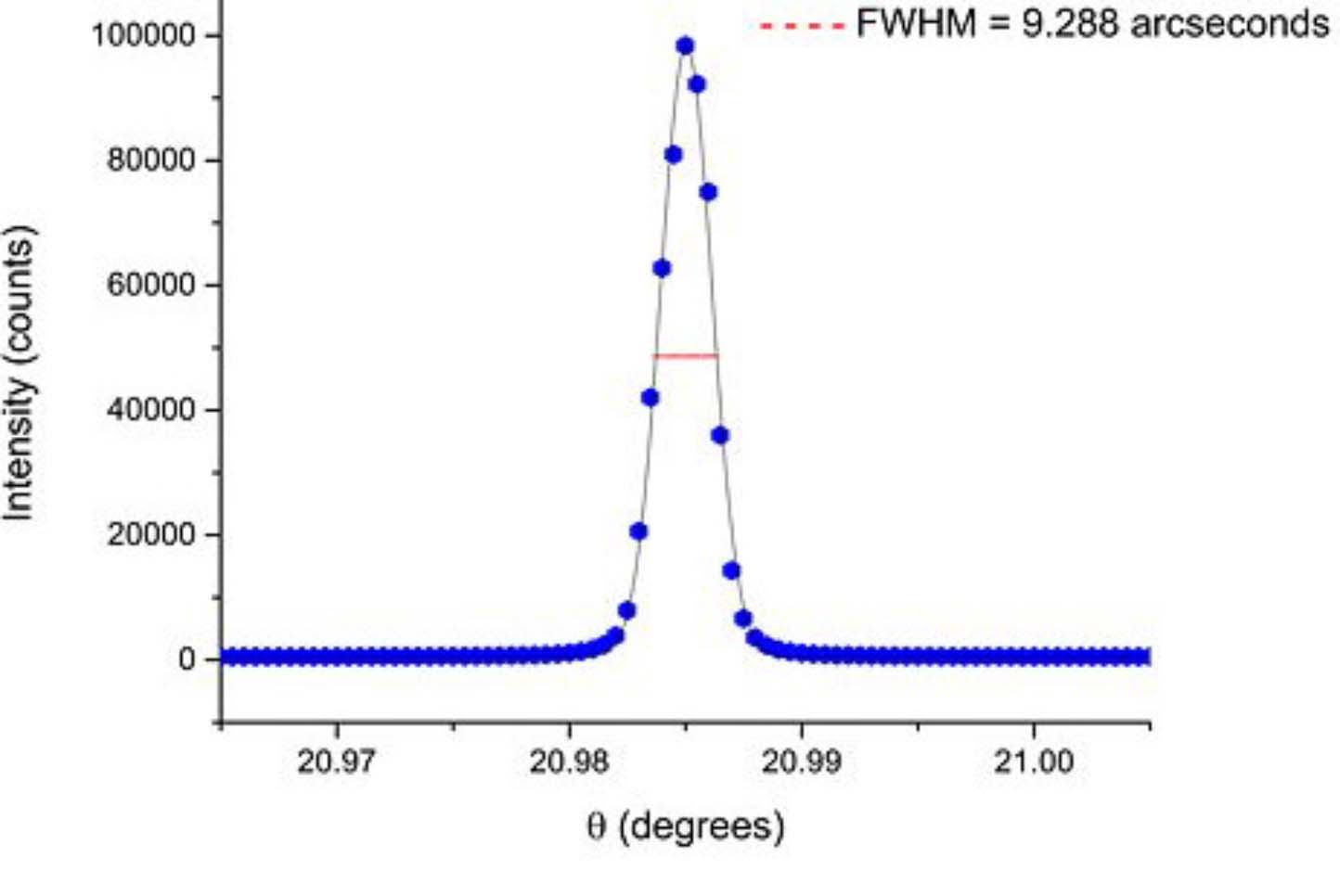
XRD Rocking Curve for Sapphire Wafer
Why Compare Irradiated and Non-Irradiated Sapphire?
Sapphire irradiation studies help researchers understand how radiation, ion beams, plasma exposure, or laser processing affect sapphire crystal quality. By comparing an irradiated sapphire wafer with a non-irradiated sapphire reference wafer, researchers can evaluate changes in:
- Crystal orientation
- Rocking curve width
- Surface damage
- Lattice strain
- Defect formation
- Optical transmission
- Thermal and mechanical behavior
Applications for Sapphire Substrate Research
Non-irradiated sapphire wafers are used in many research and production applications, including:
- XRD and rocking curve analysis
- Radiation-effect studies
- GaN on sapphire epitaxy
- LED and optoelectronic device fabrication
- High-temperature substrate testing
- Optical transmission studies
- Plasma and ion beam processing experiments
- Laser lift-off and sapphire bonding research
Because sapphire is chemically stable, mechanically strong, optically transparent, and thermally durable, it remains one of the most important substrates for advanced materials research.