
Researcher Request: “We are currently working on a growing number of PIC projects and need SOI wafers for integrated photonics circuit fabrication. Parameters: Si device layer = 220 nm, SiO₂ = 2-3 microns, diameter = 4 inch or 6 inch, monocrystalline silicon, and device layer tolerance of several nanometers.”
220 nm SOI Wafers for Integrated Photonics Circuit Fabrication
Silicon-on-Insulator (SOI) wafers are one of the most widely used substrates for integrated photonics, silicon photonics, optical waveguides, modulators, and photonic integrated circuit (PIC) fabrication. A 220 nm silicon device layer with a 2-3 μm buried oxide layer is commonly requested for low-loss optical confinement and telecom wavelength applications.
UniversityWafer, Inc. supplies SOI wafers for universities, nanophotonics labs, and device developers working on PIC-related projects.
Reference #252722 for specs and pricing.
Get Your 220 nm SOI Wafer Quote FAST!
Or,
Buy SOI Wafers Online and Start Researching Today!
Silicon Nitride Film for Integrated Photonics Devices
Silicon nitride films are used for low-loss photonic waveguides, micro-ring resonators, biosensors, quantum photonics, and visible to near-infrared optical devices. Researchers often request silicon nitride wafers deposited on a silicon oxide layer grown on a silicon wafer.
Researcher Request: “We need silicon nitride film for integrated photonics devices. The thin layer of silicon nitride should be deposited on silicon oxide grown on a silicon wafer.”
Reference #258285 for specs and pricing.
Silicon Carbide on Insulator Wafers for Integrated Photonics
Silicon carbide on insulator (SiCOI) wafers are used for advanced integrated photonics, nonlinear optics, quantum photonic devices, and high-power optical platforms. SiCOI structures typically include a thin silicon carbide layer on silicon dioxide and a silicon handle wafer.
Researcher Request: “I would like to request SiC on insulator wafers, especially 4H-SiC on insulator for integrated photonics. The desired SiC layer thickness is about 300-500 nm on 2 inch or 4 inch wafers.”
Typical SiCOI Structure: 100 mm wafer with 300-500 nm SiC on 2-3 μm SiO₂ on a silicon substrate, single-side polished.
Reference #319496 for specs and pricing.

Integrated Photonics Chip
Gallium Nitride Wafers for Integrated Photonics Chips
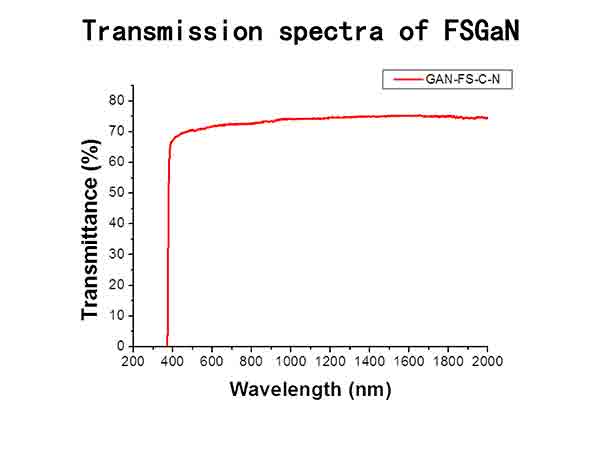
Gallium nitride (GaN) is used in photonics research because of its wide bandgap, optical transparency, and usefulness for visible, ultraviolet, and high-frequency optoelectronic devices. UniversityWafer, Inc. can supply GaN wafers for integrated photonics chip applications.
Researcher Question: “Can GaN be used for photonics applications? What are the transmittance and absorption properties from 300 nm to 2000 nm?”
Many researchers use GaN materials for photonics structures. GaN wafers are available in 2 inch to 4 inch diameters depending on the required specification.
Reference #258382 for specs and pricing.
Low-Loss Silicon Nitride Waveguides for Photonic Chips
Low-loss SiN waveguides are important for integrated photonics chips that require efficient light propagation, low insertion loss, micro-ring resonators, and compact optical circuits. Silicon nitride films can be used for passive photonic components, biosensing, frequency combs, and quantum photonics research.
Researcher Request: “Would you share information about the optical properties of your nitride film? We are interested in using the film to make low-loss SiN waveguides.”
Reference #266416 for specs and pricing.
Why 220 nm SOI Wafers are the Industry Standard for Integrated Photonics
Integrated photonic devices require substrates capable of supporting low-loss waveguides, compact optical components, and CMOS-compatible manufacturing. As a result, 220 nm Silicon-on-Insulator (SOI) wafers have become the most widely used platform for silicon photonics and photonic integrated circuits (PICs).
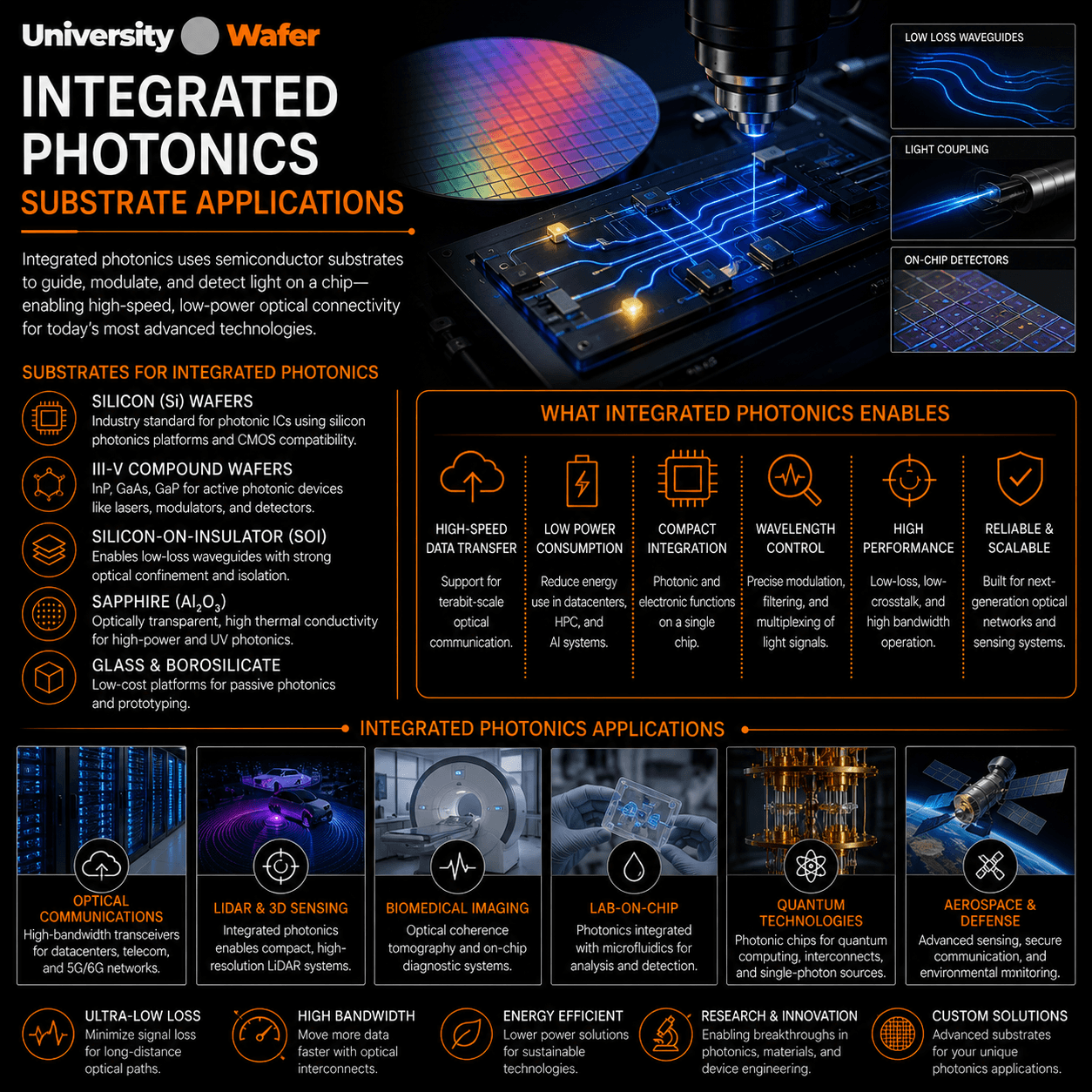
The combination of a 220 nm silicon device layer and a 2-3 μm buried oxide layer provides excellent optical confinement, enabling compact waveguides, micro-ring resonators, interferometers, modulators, and optical couplers operating near the telecom wavelength of 1550 nm.
Advantages of 220 nm SOI Wafers
- Single-mode operation at telecom wavelengths.
- High refractive index contrast for strong optical confinement.
- Low propagation loss and improved signal integrity.
- Compatibility with standard CMOS fabrication processes.
- Efficient grating couplers and micro-ring resonators.
- Established photonic design kits and manufacturing ecosystems.
Common Substrates Used for Photonic Integrated Circuits (PICs)
Modern photonic integrated circuits are fabricated using several semiconductor material platforms depending on the desired optical wavelength and device functionality.
Silicon-on-Insulator (SOI)
SOI wafers are the dominant platform for silicon photonics because of their high index contrast and compatibility with existing semiconductor manufacturing infrastructure. Typical structures consist of:
- 200-500 nm silicon device layer
- 2-3 μm buried oxide layer (BOX)
- 500-750 μm silicon handle wafer
SOI substrates are commonly used for optical waveguides, Mach-Zehnder interferometers, modulators, and photonic integrated circuits.
Silicon Nitride (SiN) on SiO₂
Silicon nitride wafers are attractive for visible and near-infrared applications because they exhibit extremely low propagation losses. SiN waveguides are widely used in frequency combs, biosensors, micro-ring resonators, and quantum photonics.
- SiN thickness: 100-400 nm
- SiO₂ cladding: 2-5 μm
- Propagation loss: <0.1 dB/cm
- Excellent power handling capability
Indium Phosphide (InP)
Indium phosphide substrates are widely used for active photonic components such as lasers, optical amplifiers, and photodetectors. Their direct bandgap properties make them ideal for optical communications operating at 1310 nm and 1550 nm.
Gallium Nitride for Integrated Photonics
GaN substrates are increasingly being investigated for integrated photonics because of their transparency, wide bandgap, and compatibility with ultraviolet and visible wavelength applications.
Silicon Carbide on Insulator (SiCOI)
Silicon carbide wafers offer excellent thermal conductivity and are becoming attractive materials for nonlinear photonics and quantum photonic devices. SiCOI structures combine SiC with oxide layers to create low-loss optical platforms.
Key Components Fabricated on Photonic Integrated Circuits
Photonic integrated circuits contain many miniature optical components, including:
- Optical waveguides
- Micro-ring resonators
- Grating couplers
- Mach-Zehnder interferometers (MZIs)
- Optical modulators
- On-chip lasers
- Photodetectors
- Frequency comb devices
These structures enable applications in telecommunications, quantum computing, LiDAR, biosensing, optical interconnects, and data communications.
Fabrication Methods for Integrated Photonic Devices
Fabrication of integrated photonic circuits typically employs advanced semiconductor processes including:
- Electron beam lithography (EBL)
- Deep UV lithography
- Reactive ion etching (RIE)
- Inductively coupled plasma (ICP) etching
- PECVD and ALD thin-film deposition
- Wafer bonding and heterogeneous integration
These processes allow the creation of highly integrated photonic chips containing intricate waveguides, resonators, and optical interconnect structures with extremely low insertion loss.