
🔵 Best Seller: C-Plane Sapphire
2 Inch (50.8mm) Wafer
Orientation: C-Plane (0001) ±0.2°
Thickness: 430µm
Polish: Single Side Polished (SSP)
The standard substrate for GaN LED research.
Sapphire Quote Request
Specify Orientation (C, R, A, M) and Grade.
Or, Buy Online and Start Researching Today!
Why Buy From Us?
- All Orientations: We stock C, R, A, and M-plane.
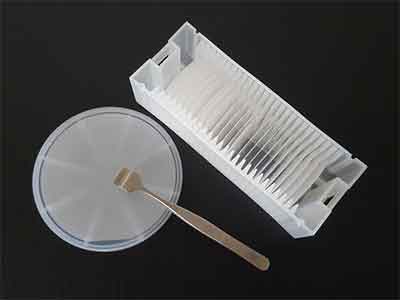
- Small Quantities: Buy 1 wafer or a full cassette of 25.
- Custom Thickness: We can polish down to 100µm or provide thick 1mm+ windows.
Can You Scribe And Break Sapphire?
A PhD candidate requested a quote for the following.
Question:
Is the Sapphire material breakable by scratching it and breaking it along the scratch?
We think about dividing it into smaller pieces. They should be 10 x 10 mm (+-1 mm).
Answer:
The short answer is yes, but with a significant caveat: Sapphire is extremely hard (9 on the Mohs scale), surpassed only by diamond and Moissanite.
-
The Scribe: You cannot use a standard steel or carbide glass cutter. You must use a diamond-tipped scribe.
-
The Technique: Because sapphire has a hexagonal crystal structure, it does not have the same easy "cleave planes" as silicon. If the wafer was cut "C-plane" (which is standard for GaN growth), it won't naturally want to break in a straight line.
-
The Risk: Manual scratching and breaking often lead to jagged edges or "shattering" rather than a clean 10x10 mm square. For precise pieces, most labs prefer wafer dicing using a diamond blade saw or laser dicing.
Reference #434762 for specs and pricing.
In-Stock Sapphire Inventory
We carry standard sizes from 10mm squares up to 8-inch wafers.
Diameter Orientation Thickness Polish Application Link 2" (50.8mm) C-Plane (0001) 430µm SSP GaN / LED Buy 2" (50.8mm) R-Plane (1-102) 430µm DSP SOS / RFIC Buy 4" (100mm) C-Plane (0001) 650µm SSP Microfluidics Buy 6" (150mm) C-Plane (0001) 1,000µm DSP Optical Window Buy 10x10mm A-Plane (11-20) 500µm DSP Hybrid Circuits Buy 
Selecting the Right Orientation
Sapphire is anisotropic, meaning its properties depend on the crystal cut. Choosing the wrong orientation can ruin your epitaxial growth.
1. C-Plane (0001)
The most common orientation. It is chemically stable and has a lattice match suitable for Gallium Nitride (GaN) growth, making it the industry standard for blue/green LEDs and laser diodes.
2. R-Plane (1-102)
Preferred for Silicon-on-Sapphire (SOS) applications. R-plane sapphire allows for the hetero-epitaxial growth of silicon, used in high-speed RFICs and pressure sensors due to its excellent electrical isolation.
3. A-Plane (11-20)
Used for hybrid microelectronic applications requiring a uniform dielectric constant and high insulating characteristics. It is also often used for optical windows where birefringence needs to be minimized along specific axes.

Growth Methods: KY vs. CZ vs. EFG
Not all sapphire is created equal. The growth method determines the defect density and cost.
Method Full Name Characteristics Best For KY Kyropoulos High optical quality, low defect density. Large diameter (6"+) LEDs & Optics CZ Czochralski Fast growth rate, good for C-axis rods. Laser rods, smaller substrates EFG Edge-defined Film-fed Grows ribbons/tubes/sheets directly. Cost-effective tubes, specialized shapes HEM Heat Exchanger Large boules, good homogeneity. Large optical windows Optical Properties
Sapphire is a rugged optical material with a transmission range from 150nm (UV) to 5500nm (IR). It is extremely hard (Mohs 9), second only to diamond, making it scratch-resistant and ideal for harsh environments.
- Refractive Index: ~1.77 (Visible)
- Thermal Conductivity: ~25 W/m·K (at 100°C) – significantly better than glass.
- Melting Point: 2040°C – survives high-temperature processing where quartz would fail.
🔬 Case Study: Durability & Cleaving
The Challenge: A researcher needed 4" and 6" substrates capable of withstanding:
- High temperatures (up to 200°C).
- Highly alkaline solutions (pH > 12).
- Multiple reworks (stripping photoresist and reusing the wafer).
The Solution: We supplied C-Plane Sapphire. Beyond its chemical inertness, C-Plane is the "softest" orientation relative to others, making it the easiest plane to cleave for downstream processing.
Reference Case #199562