
Custom Targeted Stress LPCVD Nitride Wafers
Silicon nitride (SiN) films are widely used in MEMS, microelectronics, optoelectronics, photonics, sensors, resonators, and semiconductor manufacturing. However, uncontrolled film stress can cause wafer bow, cracking, membrane failure, and reduced device performance. For many advanced applications, precise stress control is critical to achieving reliable results.
UniversityWafer, Inc. and its processing partners offer Targeted Stress LPCVD Silicon Nitride deposition designed to meet specific tensile stress requirements. Using a Tempress diffusion furnace system, researchers can obtain low-stress SiN films with excellent thickness uniformity, repeatability, and mechanical stability.
Our low-stress LPCVD silicon nitride process produces films with approximately 135 MPa internal stress, making them ideal for thin-film membranes, micro-mechanical structures, pressure sensors, resonators, and wafer-level device fabrication.
Get Your Targeted Stress LPCVD Nitride Quote FAST! Or, Buy Online and Start Researching Today!
Targeted Stress LPCVD Nitride Specifications
- Film Thickness: 50Å – 4µm
- Thickness Tolerance: ±5%
- Within-Wafer Uniformity: ±5% or better
- Wafer-to-Wafer Uniformity: ±5% or better
- Processing: Double-Sided Deposition Available
- Refractive Index: 2.05 – 2.35
- Film Stress: Custom Target ±50 MPa Tensile Stress
- Wafer Sizes: 50mm, 100mm, 125mm, 150mm, 200mm
- Wafer Thickness: 100µm – 2,000µm
- Substrate Materials: Silicon, SOI, Quartz
- Process Temperature: 800°C – 820°C
- Process Gases: Dichlorosilane (DCS) and Ammonia (NH₃)
- Equipment: Horizontal LPCVD Vacuum Furnace
What Is Targeted Stress LPCVD Nitride?
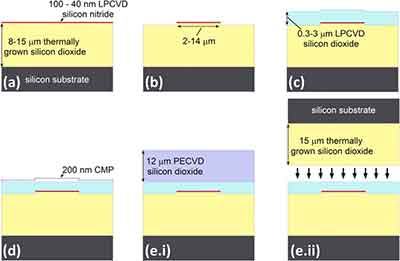 Targeted stress LPCVD nitride is a silicon nitride thin-film deposition process used when researchers need controlled film stress for MEMS, microelectronics, optoelectronics, resonators, transducers, and thin-film membrane applications. Unlike standard nitride deposition, targeted stress LPCVD SiN can be adjusted to meet specific tensile stress requirements for device performance and mechanical stability.
Why Film Stress Matters
Silicon nitride films can strongly affect wafer bow, membrane tension, device reliability, and micromechanical behavior. If the film stress is too high or inconsistent, wafers may warp, membranes may fracture, and microstructures may fail during processing. Low-stress and targeted-stress LPCVD nitride help improve repeatability for sensitive semiconductor and MEMS applications.
How LPCVD Silicon Nitride Is Deposited
LPCVD, or low-pressure chemical vapor deposition, uses a horizontal vacuum furnace to deposit uniform silicon nitride films on silicon, SOI, or quartz wafers. The process typically uses dichlorosilane and ammonia at elevated temperature to form dense, high-quality SiN films with excellent thickness control and wafer-to-wafer uniformity.
Benefits of Targeted Stress LPCVD Nitride
- Custom tensile stress targets for MEMS and resonator designs
- Low-stress SiN films for reduced wafer bow and cracking risk
- Uniform nitride thickness for repeatable device fabrication
- Compatible with silicon, silicon-on-insulator, and quartz wafers
- Useful as a membrane, mask, dielectric, passivation, or structural layer
Applications for Low-Stress SiN Films
Targeted stress LPCVD silicon nitride wafers are used in MEMS membranes, pressure sensors, microfluidic devices, resonators, photonic structures, optical coatings, transducers, passivation layers, and semiconductor research. They are also used when a silicon nitride layer must remain stable during etching, deposition, lithography, or wafer bonding.