Example Research Request:
“We need Si/SiO₂ wafers for 2D materials research. Preferred specs include 3 inch or 4 inch wafers, 285nm oxide, 525µm wafer thickness, P/Boron doping, <100> orientation, polished front surface, and etched backside.”
Thermal oxide silicon wafers feature a high-quality silicon dioxide (SiO₂) layer grown directly on the wafer surface through thermal oxidation. These substrates are widely used in semiconductor manufacturing, MEMS fabrication, gate oxide research, thin film deposition, graphene and 2D materials studies, photolithography, and advanced electronic device development. UniversityWafer offers wet and dry thermal oxide wafers with custom oxide thicknesses, diameters, dopants, resistivities, and surface finishes for both research and production applications.

Thermal oxide silicon wafers, also called SiO₂ on silicon wafers, are commonly used when researchers need a controlled insulating layer on a silicon substrate. These wafers support work in 2D materials, nanoparticles, thin film deposition, optical contrast studies, transistor research, and MEMS fabrication.
UniversityWafer supplies thermal oxide wafers in many oxide thicknesses, including thin oxide layers for device research and thicker oxide layers for insulation, masking, and optical applications.
Get Your Thermal Oxide Wafer Quote FAST! Or, Buy Online and Start Your Research Today!
Researchers frequently request 285nm and 300nm thermal oxide wafers for graphene, MoS₂, WS₂, and other 2D material studies. The SiO₂ layer provides useful optical contrast and an insulating surface for identifying and testing atomically thin films.
Example Research Request:
“We need Si/SiO₂ wafers for 2D materials research. Preferred specs include 3 inch or 4 inch wafers, 285nm oxide, 525µm wafer thickness, P/Boron doping, <100> orientation, polished front surface, and etched backside.”
Reference #209352 for specs and pricing.
Thermal oxide wafers are also used as substrates for fluorescent nanoparticles, thin films, magnetic materials, and electrical transport measurements. Researchers often choose oxidized silicon because it provides a smooth, stable surface while the underlying silicon wafer gives mechanical support.
Common research uses include:
Available specifications may include 100mm silicon wafers, P-type or N-type doping, <100> orientation, SSP or DSP polish, and oxide thicknesses from approximately 10nm to more than 10µm.
Researchers often request:
UniversityWafer can help source thermal oxide silicon wafers for research, prototyping, and laboratory testing. Share your required diameter, oxide thickness, wafer thickness, dopant, resistivity, orientation, polish, and quantity so we can quote the best available option.
Thermal oxide deposition is used to grow a high-quality silicon dioxide (SiO₂) layer directly on the surface of a silicon wafer. UniversityWafer supplies wet and dry thermal oxide silicon wafers for semiconductor fabrication, MEMS, gate oxides, dielectric layers, 2D materials research, thin film deposition, and laboratory testing.
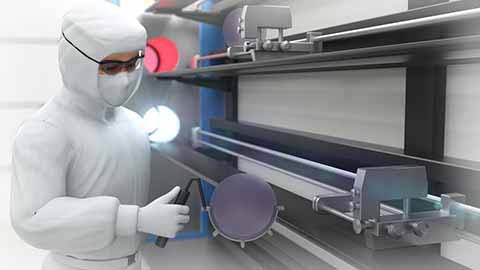
Thermal oxide can be grown using either wet oxidation or dry oxidation. Wet thermal oxide is commonly used when researchers need thicker SiO₂ layers because it grows faster. Dry thermal oxide is often selected for thinner, denser oxide layers where electrical quality and interface control are important.
Below are examples of thermal oxide silicon wafer specifications available through UniversityWafer. Custom oxide thicknesses, wafer diameters, resistivity ranges, dopants, orientations, and polish options may also be available.
| Diameter | Type | Dopant | Orientation | Resistivity | Thickness | Polish | Oxide Thickness |
|---|---|---|---|---|---|---|---|
| 50.8mm | P-Type | Boron | (100) | 1-10 ohm-cm | 280µm | SSP | 285nm Wet Oxide |
| 76.2mm | P-Type | Boron | (100) | 5-10 ohm-cm | 380µm | SSP | 100nm Dry Oxide |
| 100mm | P-Type | Boron | (100) | 1-10 ohm-cm | 500µm | SSP | 100nm Wet Oxide |
| 100mm | P-Type | Boron | (100) | 1-10 ohm-cm | 500µm | SSP | 300nm Wet Oxide |
| 100mm | N-Type | Phosphorus | (100) | 1-10 ohm-cm | 500µm | SSP | 300nm Wet Oxide |
| 100mm | P-Type | Boron | (111) | <0.005 ohm-cm | 500µm | SSP | 50nm Dry Oxide |
| 100mm | P-Type | Boron | (100) | 1-10 ohm-cm | 500µm | SSP | 10,000nm / 10µm Wet Oxide |
| 150mm | P-Type | Boron | (100) | 0-100 ohm-cm | 650µm | SSP | 300nm Wet Oxide |
| 200mm | P-Type | Boron | (100) | >1 ohm-cm | 750µm | DSP | 100nm Wet Oxide |
| 300mm | P-Type | Boron | (100) | 1-10 ohm-cm | 850µm | DSP | 300nm Wet Oxide |
Silicon dioxide thin films are widely used as dielectric materials in semiconductor devices, capacitors, MEMS structures, photolithography masks, and microelectronic components. A thermally grown oxide layer provides strong electrical insulation, good surface stability, and compatibility with standard silicon wafer processing.
Researchers often choose SiO₂ on silicon wafers for applications requiring an insulating surface, optical contrast, gate dielectric behavior, or a controlled interface for thin film deposition.
Thermal oxide silicon wafers are commonly used in MEMS, sensors, microfluidic devices, semiconductor fabrication, and research involving 2D materials. The oxide layer can act as an insulating film, structural layer, etch mask, sacrificial layer, or surface barrier depending on the process.
Because thermal oxide is grown directly from the silicon surface, it offers strong adhesion and a clean silicon-to-silicon-dioxide interface. This makes it useful for researchers who need reliable oxide layers for device prototyping and thin film experiments.
In semiconductor devices, a gate oxide is a thin dielectric layer that separates the conductive gate from the semiconductor channel. Dry thermal oxide is often preferred for thin gate oxide applications because it can provide higher film density and better electrical properties than many deposited oxides.
Thermal oxide wafers may also be used as field oxide, isolation oxide, masking oxide, and dielectric oxide layers in transistor research and advanced device fabrication.
Thermal oxide layers can appear blue, violet, yellow, green, or other colors depending on oxide thickness and lighting conditions. This color is usually caused by thin-film interference, where light reflects from the oxide surface and the oxide-silicon interface. For example, a 300nm oxide layer may appear blue-violet under certain viewing angles.
If one side of a wafer appears different from the other, it may be caused by oxide thickness variation, single-side oxidation, backside surface finish, lighting angle, or reflection from the silicon substrate. The dopant type affects the electrical properties of the wafer, but the visible oxide color is mostly related to optical interference.
UniversityWafer can also help researchers source custom silicon wafers with micro-wells, etched features, or patterned surfaces. One example request included 4 inch silicon wafers with wells approximately 1.2µm in diameter, 500-1000nm deep, and 3.0µm pitch.
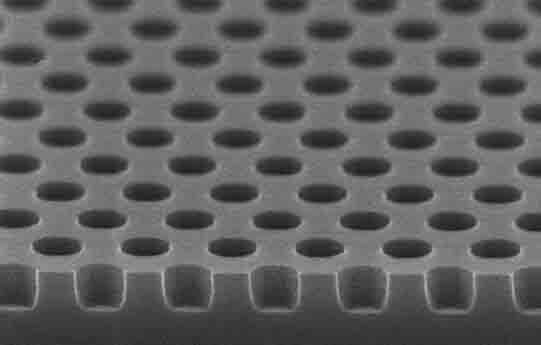
Silicon wafer with micro-wells for research applications