
I want to use silicon carbide for integrated photonic components and devices such as waveguides and ring resonators. I am interested in 4H silicon carbide on insulator (4H-SiCOI) wafers consisting of 4H-SiC thin films bonded to SiO2 on silicon carrier wafers. The wafers should be insulating, 0° off-axis, with thermally grown SiO2 at least 1 µm thick. Diameter can be either 2-inch or 4-inch. Quantity required: one wafer.
4H Silicon Carbide on Insulator (4H-SiCOI) Wafers for Photonic Devices
4H silicon carbide wafers support research into waveguides, ring resonators and quantum photonic devices. For silicon carbide on insulator (4H-SiCOI), researchers typically specify a thin 4H-SiC device layer bonded above a silicon dioxide (SiO2) insulator and a carrier wafer. Required film thickness, orientation, surface finish and oxide thickness depend on the intended photonic process.
An Electrical and Computer Engineering Ph.D. candidate requested the following:
Reference #268777 for specifications and pricing.
Applications of Silicon Carbide Wafers
Common silicon carbide wafer applications include power semiconductors, high-temperature electronics, GaN epitaxial growth and optical research. The substrate's conductivity type, crystalline quality and polishing requirements vary by application:
- SiC MOSFETs and power transistors
- SiC Schottky barrier diodes and power rectifiers
- Power converters, inverters and industrial motor drives
- GaN-on-SiC RF and microwave devices
- Integrated photonic circuits, waveguides and ring resonators
- LEDs, optical devices and quantum photonics research
- High-temperature sensors and MEMS applications
UniversityWafer offers silicon carbide substrates for university research, including research-grade and dummy-grade wafers, small samples and custom specifications. Confirm availability for your required polytype, crystal orientation, conductivity, diameter and polish.
Need SiC wafers for a research project? Shop silicon carbide wafers online or request a quote for custom 4H-SiC substrate specifications.
Current and Future Uses of Silicon Carbide Devices
Unmanned Aerial Vehicles (UAVs)
 SiC-based power devices are investigated for compact, efficient motor drives and speed controllers in unmanned aerial vehicles (UAVs). Their high-voltage capability and fast switching can help designers reduce converter losses, depending on system design.
Electric Vehicles and Formula E Racing
 In electric vehicles and racing systems, silicon carbide MOSFETs are used in traction inverters and high-efficiency power conversion. High-temperature operation and reduced switching losses can enable more compact thermal-management designs.
Silicon Carbide Schottky Diodes
 SiC Schottky barrier diodes are valued for low reverse-recovery losses in fast-switching power circuits. Research applications include solar inverters, industrial power supplies and high-frequency converters. Substrate and epitaxial-layer requirements depend on voltage rating and device architecture.
4H Silicon Carbide (SiC) Wafers for Advanced Semiconductor Research
4H-SiC substrates combine a wide bandgap, high critical electric field and good thermal conductivity. These properties make silicon carbide wafers useful in high-voltage power devices, high-frequency electronics and demanding thermal environments. Researchers choose between semi-insulating SiC for electrically isolated RF structures and conductive N-type material for many power-device structures.
 Research groups use single-crystal 4H-SiC wafers for power-device fabrication, Schottky diodes, GaN epitaxy and photonic devices. Polishing, wafer face, off-cut and defect requirements should be specified before ordering.
Can SiC Wafers Be Used for GaN and InN Epitaxy?
Yes. GaN-on-SiC substrates are important for epitaxial research using MBE and MOCVD. Silicon carbide provides a thermally conductive crystalline platform for GaN-based RF and power devices. Growth outcomes depend on substrate orientation, surface preparation, defect levels and the epitaxial process. InN growth on SiC is also investigated, but its suitability must be evaluated for the specific growth method.
- 6" 4H-N SiC, Dummy Grade
- 6" 4H-N SiC, Research Grade
- 4" 4H-N SiC, Dummy Grade
- 4" 4H-N SiC, Research Grade
- 3" 4H-N SiC, Dummy Grade
- 3" 4H-N SiC, Research Grade
- 2" 4H-N SiC, Dummy Grade
- 2" 4H-N SiC, Research Grade
- 5 mm square samples available
- Dicing services available
For a broader selection guide, see SiC wafer specifications and available silicon carbide substrate grades.
- Polytype and conductivity: 4H-SiC or 6H-SiC; N-type conductive or semi-insulating material.
- Diameter and thickness: 2-inch, 3-inch, 4-inch, 6-inch or a diced sample, subject to availability.
- Crystal orientation: on-axis or specified off-axis angle for epitaxy.
- Surface finish: single-side polished (SSP), double-side polished (DSP) or an epi-ready CMP surface.
- Electrical and quality requirements: resistivity, dopant, Si-face/C-face, TTV, bow, warp and defect tolerances.
When requesting a 4H silicon carbide wafer, include your intended use and specify the dimensions and surface/electrical properties that matter to your process. This helps distinguish a low-cost mechanical sample from an epi-ready device substrate.
How to Choose a 4H-SiC Substrate
Advantages of Silicon Carbide Substrates
- High breakdown electric field
- Excellent thermal conductivity
- Low switching losses
- Operation at elevated temperatures
- High-frequency performance
- Improved energy efficiency
- High power density
- Radiation resistance
SiC Substrate Applications in Power Electronics and RF
Single-crystal SiC wafers support semiconductor-device fabrication and materials research in the following areas:
- MOSFETs
- Schottky barrier diodes
- IGBTs
- LEDs
- RF amplifiers
- Power modules
- Electric vehicles (EVs)
- Solar inverters
- Uninterruptible power supplies (UPS)
- Photonic integrated circuits
- High-temperature sensors
- Aerospace electronics
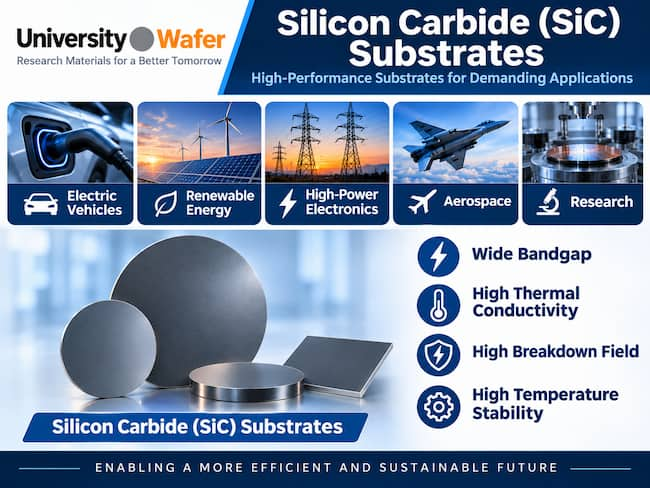
Silicon Carbide for Electric Vehicles and Aerospace
Silicon carbide power MOSFETs and diodes are used in electric-vehicle traction inverters, charging equipment, industrial drives and aerospace power conversion. At the system level, efficient switching can reduce losses and help engineers design smaller thermal-management components.
Compared with equivalent conventional silicon designs, suitable SiC power devices can support higher switching frequencies and higher voltage operation. Actual efficiency, battery-range and cooling benefits depend on device selection and the complete circuit design.
Future Applications of SiC Technology
Emerging silicon carbide substrate applications include electric aircraft power conversion, renewable-energy converters, RF systems and integrated photonics. University researchers may also explore wide-bandgap semiconductors and GaN-on-SiC heterostructures for next-generation devices.
